
Related News
- 00
0000-00
Energy-Efficient Ship Design: Matching Hull and Propeller to Service Speed - 00
0000-00
Modeling Cryogenic Tank Sloshing: When Does Phase Change Matter in CFD? - 00
0000-00
Choosing Heavy-Lift Crane Vessels for Offshore Projects: Capacity and Outreach - 00
0000-00
Choosing a Ship Component Availability Database: Stock Accuracy and Lead Times - 00
0000-00
How Low-Carbon Navigation Systems Optimize Ship Routes to Reduce Fuel Use

Start with the lift curve, not the headline capacity
A heavy-lift ship does not need a single universal crane capacity. It needs enough usable capacity to complete its planned lifts at the required radius, in the expected operating condition, with credible allowances for rigging, motion, vessel stability, and schedule risk.
That distinction matters because a crane advertised at 1,000 tonnes may be unable to lift a 1,000-tonne module where the project needs it lifted. Its maximum rating may apply only at a short radius, under a particular boom configuration, with the vessel level, ballast controlled, and environmental limits tightly constrained. Move the load farther from the crane pedestal, increase the hook height, use a different boom angle, or operate offshore rather than in sheltered water, and the available capacity can fall materially.
For a shipowner, charterer, EPC contractor, or project engineer, the practical question is therefore: what is the heaviest installed lift, at what radius, under what sea-state and wind limits, and with what consequence if the first lift window is lost? Crane selection follows from those answers.
A vessel carrying components that weigh 600 tonnes does not automatically require a 600-tonne crane. Its design lift may be 700, 800, or substantially more tonnes after all project masses and operating margins are considered. Conversely, installing an extremely high-capacity crane for a cargo profile dominated by lighter, repetitive lifts can leave the vessel with expensive idle capability and weaker commercial utilization.
The capacity calculation begins with the real lifted weight
The item described as “the cargo” is only one part of the suspended load. The crane has to lift the total hook load, which can include lifting beams, spreaders, shackles, slings, lifting frames, subsea handling equipment, hook blocks, and temporary installation aids. For offshore work, the relevant mass may also include water-filled components, soil interaction effects during extraction, or equipment retained below the hook until the item is secured.
A disciplined early-stage estimate separates at least four values:
- Dry item weight: the fabricated module, structure, turbine component, process skid, or industrial cargo itself.
- Rigging and lifting-tool weight: all permanent and project-specific equipment between the crane hook and the load.
- Operational load allowance: an allowance related to motion, control method, lifting phase, and project procedures.
- Required capacity at radius: the crane-chart value needed after the load and operating allowances are applied.
This is why a quoted “maximum cargo unit” can be misleading during vessel screening. A 750-tonne subsea structure may become a significantly larger hook load once its lifting frame and rigging are included. A heavy deck module may require a long outreach to clear vessel structure or reach its final set-down point. The required crane rating is determined by that combined condition, not by the module weight in isolation.
For transport-only voyages, the crane may mainly support loading, discharge, and contingency handling. For installation vessels, its role is more demanding: it must transfer the load through critical phases, potentially hold it while the vessel ballasts or repositions, and place it within defined positional tolerances. The latter work calls for a more conservative capacity assessment.
Lift radius usually changes the answer more than expected
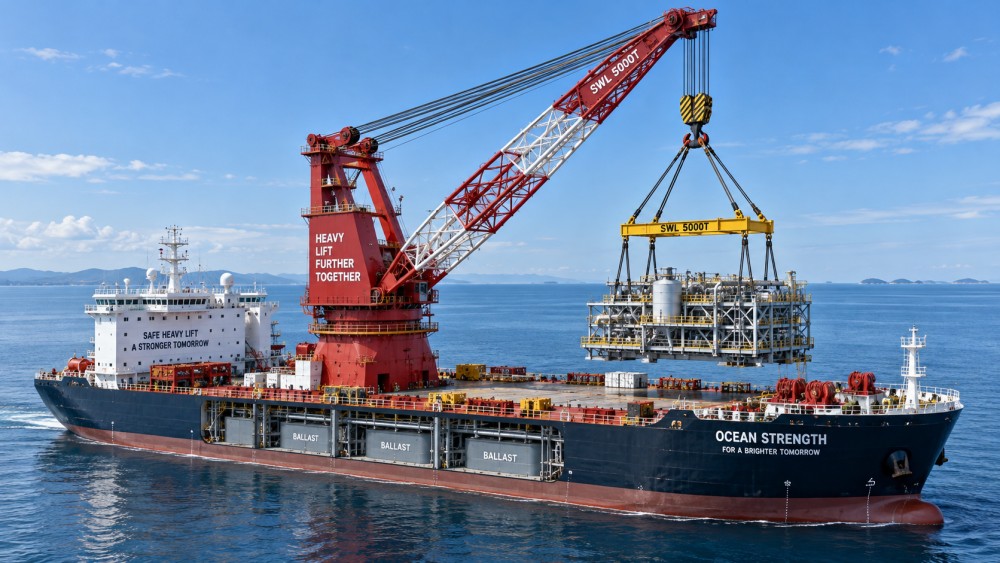
Every serious crane evaluation should use the manufacturer’s load chart, not a single capacity figure from a vessel brochure. Crane capacity declines as the working radius increases because the overturning moment at the pedestal rises. The relevant radius is the horizontal distance from the crane’s center of rotation to the load’s center of gravity, measured in the planned lifting geometry.
A lift that appears straightforward on deck can become restrictive during over-side installation. The crane may pick the item close to the pedestal, rotate it clear of deck cargo, then lower it over the vessel side at a much greater radius. The controlling point is often not the initial pick. It may be the moment the load clears a bulwark, passes a jacket leg, reaches a subsea landing point, or must be held away from a structure while the vessel maintains position.
Hook height and boom arrangement also deserve early attention. A crane can have sufficient load capacity while lacking the geometry to place the item where it must go. Boom length, luffing range, clearance over cargo, interference with accommodation blocks, and the location of other cranes all affect usable reach. On a vessel with multiple cranes, tandem lifting may expand the operating envelope, but it should not be treated as a simple way to add two headline capacities together.
Tandem lifts require compatible controls, agreed load-sharing assumptions, rigging geometry, communications, vessel-motion analysis, and procedures for abnormal events. The load split changes throughout the lift. In many projects, a single-crane solution with adequate radius capacity is operationally simpler than a tandem lift that is technically possible but difficult to execute within weather and procedural constraints.
Offshore capacity is a vessel-and-crane system question
In port or sheltered water, a crane can often work under conditions closer to its static chart. Offshore lifting introduces vessel motions, wind loading, dynamic behavior of the suspended load, and limits on maintaining position. The crane rating that matters is the approved offshore operating capacity for the intended configuration, rather than an idealized static maximum.
Heave, roll, pitch, and yaw can create relative movement between a vessel and a fixed or floating target. A load being transferred to a platform, lowered near subsea infrastructure, or installed alongside another vessel can see higher forces than its static weight suggests. The dynamic effects depend on the sea state, wave direction, lifting duration, vessel response, hook height, suspended length, and whether the receiving point is fixed or moving.
Dynamic positioning capability may expand the practical range of offshore tasks, but it does not remove lifting limits. The vessel still needs sufficient stability and station-keeping performance for the approved operating condition. Its environmental limits should be compatible with the project location and work season. A crane that can execute a lift only in narrow weather conditions can be commercially weak even when its nominal capacity looks adequate.
For this reason, project teams should avoid asking only, “Can the crane lift it?” The better sequence is:
- Can it lift the complete hook load at the maximum required radius?
- Can it do so in the intended boom configuration and hook-height range?
- Is that capacity valid for the vessel’s offshore operating condition?
- What weather, sea-state, wind, and visibility limits govern the lift?
- Can the vessel maintain stability, position, and safe deck operations throughout the lift?
The answers should be reconciled with the lift study, vessel stability book, crane documentation, class requirements, operating manual, and project-specific marine warranty expectations where applicable. A preliminary screening can use conservative assumptions, but execution planning needs configuration-specific engineering.
Vessel stability can become the limiting factor
Crane capacity is inseparable from vessel stability. Suspending a load at radius changes the vessel’s center of gravity and generates a heeling moment. As the crane slews, luffs, or lowers the load, the stability condition changes again. Deck cargo, fuel, ballast, consumables, crane boom position, and free-surface effects in partially filled tanks can all influence the allowable lift.
A heavy-lift vessel may carry a high-rated crane yet face reduced lifting capability at certain drafts, cargo arrangements, or ballast conditions. Semi-submersible vessels, monohulls, crane barges, and ships with elevated installation equipment each have different stability and motion characteristics. The right selection is not simply a matter of choosing the largest crane. It requires matching the crane to the hull, ballast system, deck layout, transit profile, and operating mode.
This is especially relevant for vessels expected to perform both transportation and installation. A deck loaded for a long ocean transit may not match the optimal arrangement for installation operations. Cargo sequencing can determine whether the required module is accessible at the needed radius. It may also affect whether ballast adjustments can be made without disrupting another part of the campaign.
Early feasibility work should therefore map the lift sequence, not merely list maximum component weights. The heaviest piece is important, but the most demanding lift may be a lighter item removed late in the voyage from an obstructed deck position, at a larger radius and less favorable stability condition.
How much margin should a project carry?
There is no responsible universal rule that says a heavy-lift ship should have a fixed percentage more crane capacity than the cargo weight. The required margin depends on the type of lift, the certainty of weight and center-of-gravity data, the operating environment, the crane chart, the lifting method, and contractual tolerance for delay.
What should be avoided is selecting a vessel whose chart capacity is nearly equal to the estimated hook load at the controlling radius. That leaves little room for changes in final fabrication weight, rigging design, center-of-gravity position, weather restrictions, or revised installation geometry. It can also create a late-stage problem when detailed engineering replaces a preliminary cargo estimate with an actual certified weight.
Capacity margin has commercial value when it reduces weather sensitivity, avoids complex tandem lifts, accommodates reasonable design development, or allows the vessel to bid for adjacent project types. It has a cost as well. Larger cranes add capital expenditure, structural reinforcement, power demand, maintenance obligations, crew competence requirements, and often a higher day rate. The right margin is the one supported by the vessel’s target project pipeline, rather than an arbitrary preference for the biggest available crane.
A practical way to screen vessel suitability
During early chartering or newbuild evaluation, a concise lift matrix is often more useful than a brochure comparison. List each critical lift, the complete estimated hook load, pick radius, set-down radius, required hook height, operation type, environmental limits, and any need for rotation, upending, subsea lowering, or tandem operation. Then test those lifts against each candidate vessel’s approved chart and operating limitations.
This process often reveals that vessel suitability is more nuanced than a capacity ranking. A vessel with a lower nominal maximum may be the stronger option for a particular campaign because its crane has better outreach, its deck layout improves access, its stability envelope suits the lift sequence, or its operating limits align more closely with the site conditions.
Choose capacity for the mission, not for a marketing number
For simple port handling of oversized industrial cargo, the primary requirement may be adequate chart capacity at a known berth radius, with allowance for rigging and a workable deck arrangement. For offshore wind, subsea construction, decommissioning, or deepwater infrastructure work, the assessment must extend to dynamic behavior, vessel motions, positioning, stability, hook height, and weather-window exposure.
The useful answer to “What crane capacity is needed for a heavy-lift ship?” is therefore a project-specific capacity envelope. Define the heaviest realistic hook load, identify the largest radius and most restrictive phase of each lift, test it against approved offshore conditions, and retain enough margin for final engineering and operational uncertainty. A crane becomes commercially valuable when it can perform the planned lift reliably, not when its maximum tonnage is impressive in isolation.