
Related News
- 00
0000-00
Choosing a Ship Component Availability Database: Stock Accuracy and Lead Times - 00
0000-00
How Low-Carbon Navigation Systems Optimize Ship Routes to Reduce Fuel Use - 00
0000-00
How Shipbuilding Supply Chain Lead Times Affect Vessel Delivery Schedules - 00
0000-00
Maritime Digitalization: Where Fleet Operators Can Cut Fuel and Compliance Risk - 00
0000-00
Class Approval for Podded Thrusters: Design, Testing, and Vessel Integration Requirements

A published deck rating is only a starting point. To verify a heavy-lift vessel’s deck load limits, buyers need to match the proposed cargo arrangement to the vessel’s approved structural documents, not simply compare cargo weight with a brochure figure. The relevant question is whether the weight, footprint, support points, sea-fastening loads, and operating condition are acceptable at the intended deck location.
This distinction matters for offshore modules, transformers, reels, cranes, subsea equipment, tracked machinery, and project cargo on transport barges or heavy-lift ships. A vessel may have ample total deadweight while still being unable to accept a concentrated item at a specific position on deck.
Start with the actual cargo load case
Before requesting vessel confirmation, prepare a cargo data sheet that describes more than the item’s total mass. The vessel operator, naval architect, and class-facing engineering team need enough information to assess how the deck will be loaded in reality.
- Total lifted, shipped, and landed weight, including grillage, lifting frames, transport saddles, and permanent sea fastenings.
- Overall dimensions and the proposed deck footprint.
- Number, spacing, and geometry of support points.
- Load at each support point or along each skid, beam, wheel, crawler track, or saddle.
- Center of gravity in all relevant directions.
- Expected route, season, port operations, and whether the cargo will be loaded afloat or by shore crane, skidded, rolled, or lifted into position.
- Sea-fastening concept, including where welded stools, braces, or hold-down devices will transfer forces into the deck.
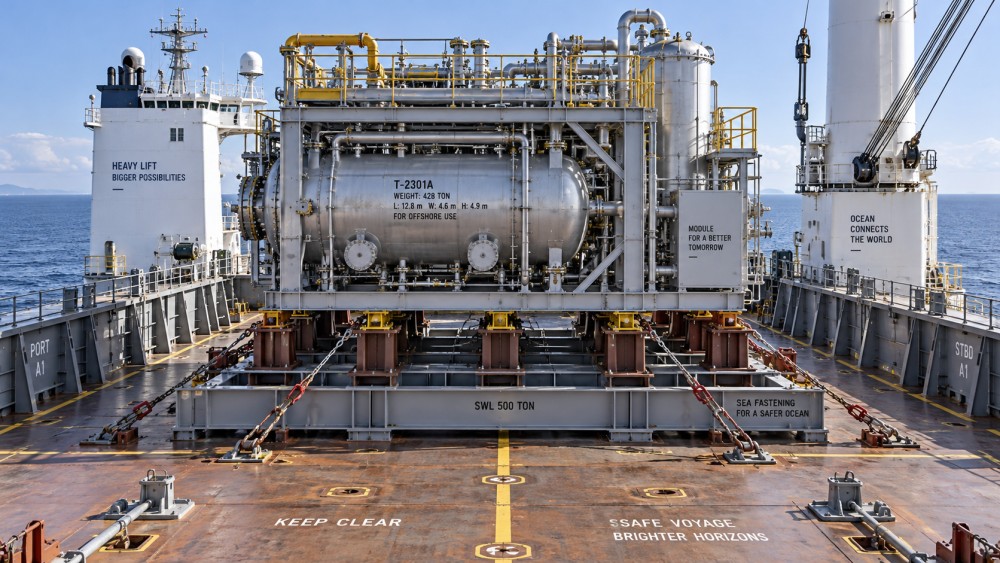
“The unit weighs 500 tonnes” is not a deck-load calculation. A 500-tonne module spread across a broad engineered grillage can be less demanding than a much lighter machine standing on narrow feet. Likewise, a crawler crane may create high local loads at track edges, while a skid-based item can create concentrated reactions where skid beams terminate.
What deck ratings do and do not tell you
A deck may be described with a uniform load rating, often expressed as weight per unit area. That figure can be useful for early screening, but it does not establish approval for a heavy cargo shipment. Uniform load assumes the load is distributed across an area in the manner contemplated by the vessel design. Project cargo rarely behaves that way.
Buyers should be especially cautious when a deck rating is presented without stating whether it applies to the whole deck, a defined cargo zone, a hatch cover, a pontoon top, or a reinforced strip. It may also be valid only under a specified loading condition. A heavy-lift vessel can have different structural limits forward, amidships, aft, over tanks, near deck openings, or above machinery spaces.
Request the approved documents, not a sales summary
How do I verify heavy lift vessel deck load limits in a defensible way? Ask for a document package tied to the nominated vessel and intended voyage. The core records should be current, vessel-specific, and detailed enough for a competent marine engineer to trace the load path.
1. Approved deck strength plan
This is normally the first technical document to review. It should identify deck zones, structural boundaries, permissible distributed loads, local restrictions, openings, and any reinforced areas. The plan helps establish whether the cargo is being placed in a structurally suitable region before more detailed calculations begin.
Read the notes as closely as the values. A stated deck capacity may exclude point loads, require load spreading, prohibit loading over a particular structure, or depend on a support arrangement. Do not assume an area between two marked zones has the higher of the two ratings.
2. General arrangement and structural drawings
A general arrangement drawing shows available working space, obstructions, deck elevations, crane locations, access routes, and the relationship between the proposed cargo and vessel features. Structural drawings go further by showing primary members, such as girders, frames, bulkheads, and transverse structure that carry deck loads into the hull.
These drawings matter because placement directly over strong internal structure is often preferable to placing a high reaction load in an unsupported panel. The final arrangement may therefore need to move a cargo support point, alter grillage beam spacing, or use a different stowage orientation.
3. Cargo load-distribution and grillage calculations
The calculation package should convert the cargo arrangement into deck reactions. It should address the cargo’s static weight, the grillage’s own weight, individual support loads, and the structural function of the grillage. A grillage is not merely a steel platform that makes a footprint look larger. It must transfer load into suitable deck areas without creating new concentrated loads at its own supports.
For heavy or irregular cargo, the calculation should also consider uneven weight distribution. If the center of gravity is offset, equal-looking supports may not carry equal loads. Fabrication tolerances, hull deflection, and imperfect bearing contact can further shift reactions, so the arrangement should not rely on every support carrying exactly the same share.
4. Sea-fastening design and dynamic load assessment
Deck verification does not end when the cargo is resting on its supports. At sea, vessel motions create longitudinal, transverse, and vertical forces. Braces, lugs, stools, and welds transmit those forces into the deck and supporting structure. A cargo arrangement can be acceptable under static weight yet become unsuitable once restraint loads are added.
Review the sea-fastening drawing together with the deck plan. It should identify attachment points, weld details, load directions, and reinforcement where required. A seemingly minor change, such as moving a diagonal brace or using a different lashing angle, can redirect force into a deck area that was not evaluated for it.
Check the vessel condition behind the calculation
Deck strength is one part of a wider vessel suitability decision. A sound approval also depends on the condition under which the vessel will sail and operate. Cargo location affects draft, trim, stability, visibility, access to essential equipment, crane operations, and port restrictions.
For example, moving a module aft may reduce a local deck concern but create an unfavorable trim condition. Raising cargo on tall stools may solve an interface problem while increasing windage and shifting the vertical center of gravity upward. A placement that works during calm-water loadout may not be suitable for the anticipated voyage condition.
The approval should therefore state the operative assumptions: cargo position, support layout, ballast condition, voyage or operating profile, and any restrictions that apply. If the project later changes the cargo weight, center of gravity, grillage configuration, or stowage position, the prior acceptance should not be treated as automatically transferable.
Use class and vessel records as evidence, not as a substitute for engineering
Class records and vessel certificates help establish the vessel’s identity, maintenance framework, and applicable survey status. They are important due-diligence documents, particularly when chartering a vessel for a high-consequence project. However, class status alone does not mean a specific module can be placed anywhere on deck.
What buyers need is a vessel-specific engineering acceptance for the stated cargo arrangement. Depending on the project and contractual requirements, this may involve review by the vessel’s technical team, an appointed marine warranty function, class involvement, or another agreed independent authority. The point is not the label of the reviewer; it is that the proposed load case has been assessed against the vessel’s approved structural basis.
Common mistakes that create late-stage problems
The most expensive errors often begin with an oversimplified comparison: cargo weight versus advertised deck capacity. This can lead to a charter commitment before the actual support reactions, stowage constraints, and sea fastening have been designed.
- Using total cargo mass as the deck load. Include transport frames, grillage, stools, sea fastenings, temporary works, and installation equipment that remains on deck.
- Dividing weight by the cargo’s overall footprint. The structural deck sees the load through actual contact points, not the visual outline of a module.
- Assuming a larger grillage is always safer. A poorly designed grillage may shift high reactions to unsuitable locations or behave unevenly.
- Reviewing the cargo supports but ignoring restraint loads. Welded sea fastenings and braces can govern the local structural requirement.
- Reusing an old approval. Similar cargoes, vessels, or prior voyages may differ in support geometry, cargo center of gravity, route, and vessel condition.
- Approving a plan before the final cargo weight is known. Late changes to equipment, fluids, removable items, or transport frames can invalidate the original load assumptions.
A practical buyer workflow before charter commitment
For an early commercial decision, screen the candidate vessel against the cargo’s approximate footprint, overall dimensions, weight, lifting method, and likely stowage zone. This can eliminate clearly unsuitable options without pretending to provide final approval.
Before fixing the vessel or releasing fabrication of grillage and sea fastening, issue the final cargo data and request an engineered stowage proposal. Review the proposed arrangement against the approved deck plan, support reactions, structural drawings, stability condition, and sea-fastening design. The completed package should clearly identify limitations, such as prescribed cargo position, load-spreading requirements, restricted operations, or weather-related operating boundaries.
Finally, control changes during execution. The cargo, grillage, and vessel must match the approved configuration. Substituting material, adding equipment, shifting a stool, changing a weld location, or relocating cargo for operational convenience can alter the structural result. A disciplined change process is often more valuable than a thick document package prepared before loadout.
Questions buyers often ask
Can a vessel carry cargo that exceeds its published deck rating if grillage is used?
Possibly, but not because grillage overrides the rating. Proper grillage can distribute cargo reactions into structurally suitable areas. The resulting arrangement still requires calculation and approval for the exact deck location, support geometry, and sea-fastening loads.
Is a flat deck automatically suitable for heavy machinery?
No. A flat working surface says little about the structure below it. Heavy machinery may impose concentrated wheel, track, skid, or foot loads that require reinforcement or a purpose-designed transport foundation.
Who should produce the final deck-load calculation?
The calculation should be prepared or accepted by parties with responsibility for the vessel and cargo arrangement, using approved vessel information. Buyers benefit from ensuring that the calculation, stowage drawing, and sea-fastening design are coordinated rather than commissioned as disconnected documents.
What should be confirmed first when comparing several candidate vessels?
Confirm whether each vessel has a suitable approved deck zone for the cargo’s actual support layout. Total deck area and headline deck ratings are useful filters, but the available structural load path is the faster way to identify whether a candidate is genuinely viable.
For complex offshore transport decisions, maritime intelligence sources such as MO-Core can help buyers frame the right technical questions around engineering-vessel capability. The final decision, however, should rest on the nominated vessel’s approved drawings and the completed engineering assessment for the actual cargo arrangement.