
Related News
- 00
0000-00
Maritime Digitalization: Where Fleet Operators Can Cut Fuel and Compliance Risk - 00
0000-00
Class Approval for Podded Thrusters: Design, Testing, and Vessel Integration Requirements - 00
0000-00
How a twin engine load sharing system prevents uneven loading - 00
0000-00
Can Shipping Delays Invalidate a Shipbuilding Project Schedule? - 00
0000-00
How Supply Chain Disruption Changes Inventory, Sourcing, and Delivery Risk Planning
Tags

A twin engine load sharing system prevents uneven loading by making both engines respond to the same power demand while continuously correcting the small differences that develop in real operation. It does not simply command both governors to the same speed. It compares each engine’s actual contribution, then adjusts fuel or torque reference so neither unit is left carrying a disproportionate share of propulsion or generator load.
For maintenance work, this distinction matters. Two engines can display nearly identical RPM and still be badly load-imbalanced. One engine may be supplying most of the torque while the other is only following speed. The vessel may continue operating, but the overloaded engine sees higher thermal and mechanical stress, while the lightly loaded engine may run inefficiently, foul more easily, or fail to accept load when it is needed.
Uneven loading starts when speed control is mistaken for load control
Parallel engines must agree on frequency or shaft speed, but speed stability alone does not prove proper sharing. In an electric propulsion or genset arrangement, the system normally uses a load signal such as active power, current, torque, or a calculated load value. In mechanical twin-engine propulsion, the signal may be derived from shaft torque, clutch condition, or another shared-load reference.
The governing principle is simple: each engine should contribute its intended proportion of the total demand. In a symmetrical two-engine arrangement, that is often close to an equal split. It does not always need to be exactly equal. A vessel may deliberately assign a lead engine, preserve a reserve margin, or limit one engine because of an operating restriction. The important point is that the split is intentional, stable, and within the equipment maker’s permitted operating range.
Without a coordinating function, small differences in governor response become self-reinforcing. An engine whose fuel rack, actuator, sensor, or control setting responds slightly faster will pick up more load. As demand rises, it continues to work harder while the other engine remains near the same speed but contributes less. A load-sharing controller detects this mismatch and trims the command references to bring the engines back toward the target split.
What the system is actually balancing
A load-sharing scheme generally combines three control jobs. They are related, but they should be diagnosed separately.
In generator applications, active load sharing is usually the first concern because it determines how much real power each prime mover supplies. Reactive power or voltage sharing is a separate issue. A set can share kilowatts correctly but still show poor current balance because excitation control is not coordinated. Treating an excitation problem as a governor problem can lead to unnecessary adjustments and does not correct the underlying condition.
For propulsion systems, the equivalent question is usually torque contribution. When engines drive a common gearbox or are coordinated through an electrical propulsion plant, unequal torque can overload one drivetrain path even though vessel speed appears normal. The control architecture differs, but the maintenance logic remains the same: verify the measurement, verify the command path, then confirm the final engine response.
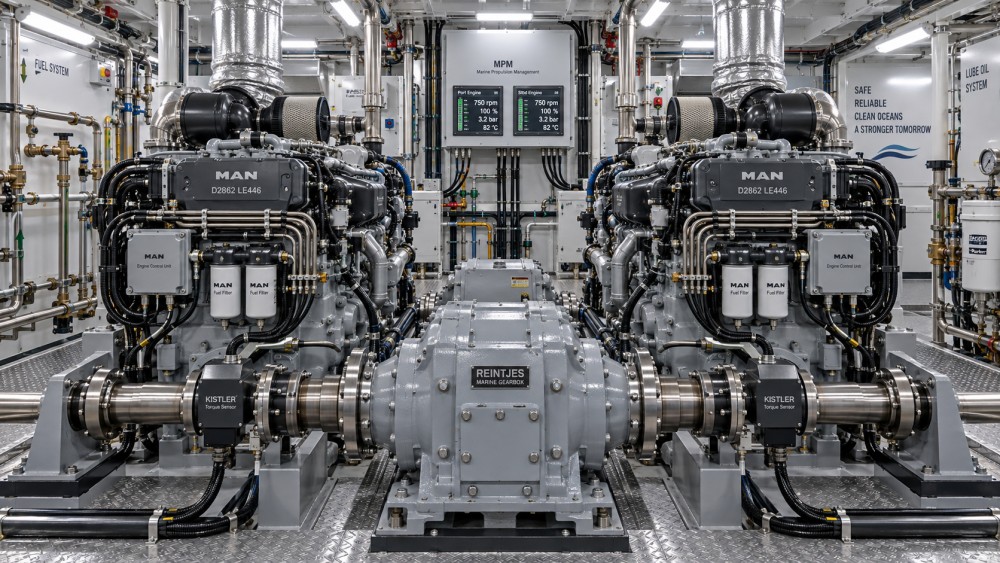
How closed-loop sharing prevents one engine from becoming the “worker”
A properly configured twin engine load sharing system works as a closed loop. Each engine’s controller receives a load-related measurement and exchanges data or a common bias signal with the other controller. The control logic calculates the difference between actual and required sharing. It then raises or reduces the fuel, torque, or speed-bias command in small increments until the mismatch is reduced.
This correction must be progressive. If the controller reacts too aggressively, both engines can chase each other: one loads up, the other unloads, then the direction reverses. The result is load oscillation, unstable frequency, drivetrain shock, and avoidable alarm events. If the correction is too slow, the system may be stable but allow a damaging imbalance during maneuvers or step-load changes.
Droop control is often used to make parallel operation inherently stable. In a droop arrangement, engine speed reference reduces slightly as load increases. Engines with matched droop characteristics naturally share load when connected to a common bus or mechanical system. Isochronous sharing, by contrast, holds speed more tightly and uses communication or a dedicated load-sharing function to distribute load. Neither arrangement is automatically better; the correct choice depends on the vessel’s control design, redundancy philosophy, and original equipment configuration.
A common maintenance error is to alter droop settings to hide a bad signal or actuator problem. That may make the displayed split look better at one operating point, then create poor pickup or hunting at another. Control settings should be changed only after the measuring chain and actuator behavior have been checked.
The causes of imbalance are often outside the controller
When one engine carries more load, the load-sharing module is an obvious suspect, but it is not always the cause. The controller can only act on the information it receives and the authority it has over the engine. Fault finding is more reliable when the system is viewed as a complete chain.
1. Incorrect or inconsistent load measurement
Current transformers, power transducers, torque sensors, analogue scaling, polarity, phase association, and communication values all affect the controller’s view of load. A biased measurement can make a healthy engine look overloaded or underloaded. The controller then makes the wrong correction with complete confidence.
Compare independent indications where possible. A local engine display, switchboard meter, controller diagnostic value, and portable measurement should tell a consistent story. If they do not, do not begin