
Related News
- 00
0000-00
Maritime Digitalization: Where Fleet Operators Can Cut Fuel and Compliance Risk - 00
0000-00
Class Approval for Podded Thrusters: Design, Testing, and Vessel Integration Requirements - 00
0000-00
How a twin engine load sharing system prevents uneven loading - 00
0000-00
Can Shipping Delays Invalidate a Shipbuilding Project Schedule? - 00
0000-00
How Supply Chain Disruption Changes Inventory, Sourcing, and Delivery Risk Planning

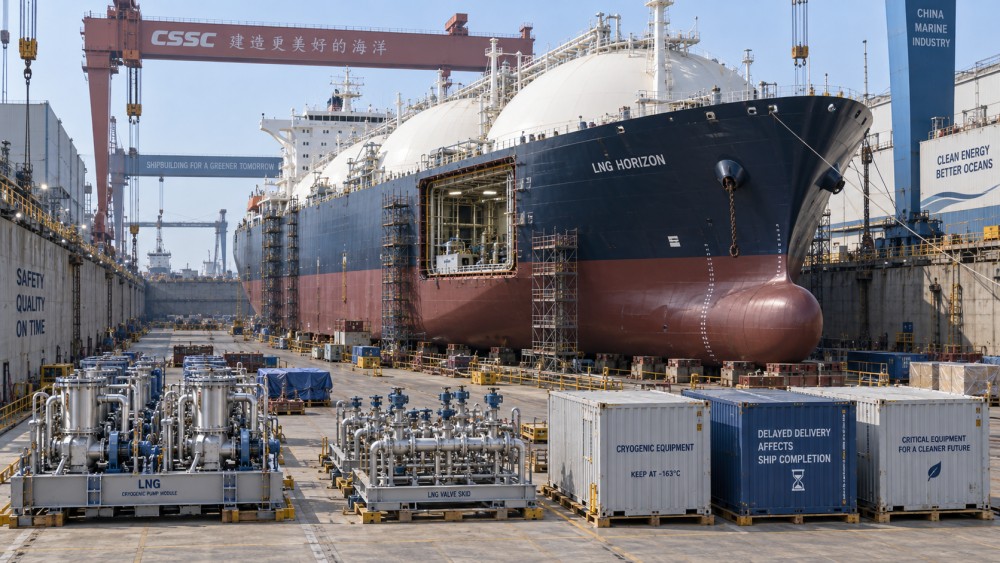
A vessel may look complete on a master schedule long before its final systems have arrived. A delayed valve skid, a missing cable batch, a late cryogenic pump, or an absent SCR reactor module can leave a high-value project waiting at exactly the wrong moment. That is why the question “Can shipping delays invalidate a shipbuilding project schedule?” matters far beyond logistics.
The short answer is: yes, shipping delays can make a shipbuilding schedule unachievable—but they do not automatically erase the schedule’s contractual validity. Whether a delay changes completion dates, triggers liquidated damages, permits an extension of time, or simply requires recovery planning depends on critical-path impact, contract language, evidence, and the shipyard’s ability to mitigate.
For LNG carriers, cruise vessels, offshore engineering ships, and electric-propulsion projects, this distinction is especially important. These vessels depend on tightly coordinated packages whose interfaces are difficult to substitute at short notice. A late delivery may be only a logistics event on paper; in practice, it can interrupt installation, testing, class inspection, commissioning, sea trials, and delivery to the owner.
When a Late Shipment Becomes a Schedule-Invalidating Event
Not every delayed container changes the project completion date. Shipyards routinely absorb small disruptions through buffer stock, parallel work, resequencing, or overtime. A shipping delay becomes serious when it affects an activity on the critical path—the chain of tasks that determines the earliest possible completion of the vessel.
Consider an LNG carrier approaching machinery-space completion. If a non-critical set of cabin fittings arrives late, interior teams may switch zones and continue working. If the delayed item is a specialized LNG cargo-system component required before pressure testing and gas trials, alternatives may be limited. Installation cannot close, test procedures cannot begin, class surveyors cannot sign off, and downstream milestones move together.
The same pattern appears across high-value shipbuilding:
- Electric propulsion: late variable-frequency drives, transformers, switchboards, propulsion control cabinets, or podded-thruster interfaces may block energization and harbor acceptance tests.
- Exhaust-gas treatment: delayed scrubber pumps, washwater monitoring equipment, SCR catalyst modules, or control hardware can affect emissions-compliance testing.
- Cruise ship systems: missing fire-rated partitions, specialized HVAC components, galley equipment, or safety-system interfaces can delay handover of entire accommodation zones.
- Offshore and engineering vessels: late cranes, cable-lay equipment, subsea handling systems, or DP-related equipment may postpone integration trials that cannot be compressed easily.
The real question is not, “Was the shipment late?” It is, “Did the late shipment consume available float and prevent a contractual milestone from being achieved?”
“Invalid” Can Mean Different Things to Different Parties
In project controls, a schedule may be called “invalid” when it no longer represents a realistic delivery plan. In a contract dispute, however, invalidity is rarely the useful term. The parties typically examine entitlement and responsibility: is the shipyard entitled to more time, is the supplier liable for delay, can the owner impose delay damages, and was the delay foreseeable or avoidable?
A shipping delay can affect a shipbuilding project schedule in four distinct ways:
- It makes the baseline schedule obsolete. The original sequence and dates no longer reflect physical reality, so the plan must be updated and reforecast.
- It creates a compensable or excusable delay. Depending on the contract, a qualifying event may support an extension of time, additional cost, or both.
- It creates concurrent delay. The shipment may be late while the shipyard is also behind on steelwork, design approvals, or access readiness. This can complicate claims significantly.
- It becomes a recoverable disruption rather than a final delivery delay. The affected work may be resequenced successfully, but at the cost of congestion, overtime, reduced productivity, or added expediting.
For this reason, a late shipment does not automatically excuse a missed delivery date. If the shipyard had adequate float, failed to issue purchase orders on time, did not arrange agreed expediting, or could have installed an approved equivalent, the causal link may be weak. Conversely, even a relatively short delay can be decisive when it hits a single-source system at the commissioning stage.
What the Contract Usually Decides
Shipbuilding contracts, purchase orders, and logistics agreements should be read together. A vessel builder may have one set of obligations to the owner and a different set of remedies against an equipment supplier or freight provider. A gap between those documents is where commercial exposure often grows.
Key clauses commonly include delivery terms, Incoterms, notice requirements, force majeure, change-order procedures, liquidated damages, limitation of liability, inspection rights, and requirements for mitigation. The exact allocation of risk may turn on a seemingly small detail: when risk passed, who selected the carrier, whether the supplier was responsible for export packing, or whether transport was included in the equipment delivery obligation.
Incoterms do not, by themselves, settle schedule liability. They help define delivery, cost, and risk transfer between buyer and seller, but project delay responsibility must still be interpreted under the relevant contract. For example, cargo risk may transfer at loading while the supplier remains responsible for achieving a stated delivery date at the yard. Conversely, a shipyard that appointed the freight forwarder may struggle to pass a carrier-related delay back to the equipment manufacturer.
Notice provisions deserve particular attention. Many contracts require written notice within a defined period after the delaying event becomes known. A project team that waits until the vessel’s delivery date is visibly at risk may lose leverage, even if the underlying shipping problem was genuine.
A Practical Test: Is the Delay Truly Critical?
Before declaring that shipping delays have invalidated a shipbuilding project schedule, the project team should conduct a disciplined impact review. This is not merely a logistics update. It is a planning, engineering, procurement, and contractual exercise.
1. Confirm the exact item and interface
Identify the delayed material by part number, revision, quantity, package, and installation location. Check whether the item is a standalone component or an interface-dependent part. A cable gland may be easily sourced; a class-approved LNG vapor-handling component, configured for a particular containment arrangement, may not be.
2. Trace the impact through the integrated schedule
Map the delivery delay to installation, pre-commissioning, commissioning, class surveys, flag-state documentation, port trials, sea trials, and owner acceptance. A credible analysis distinguishes between a late arrival at the gate and a delay to the vessel’s contractual delivery milestone.
3. Measure available float honestly
Float is not an invitation to ignore risk. It is a limited project resource, often shared by multiple activities. Teams should determine whether the delay uses only local float or consumes total float on the critical path. An update that hides the effect through unrealistic logic links or unexplained constraints may create more trouble later.
4. Test practical mitigation options
Can the work be resequenced? Can installation proceed in another zone? Is partial shipment possible? Is there an approved alternate source? Could a temporary arrangement support testing without compromising class requirements, safety, or warranty? The answer must be technical as well as commercial.
5. Preserve contemporaneous evidence
Keep carrier notices, port records, packing lists, inspection reports, correspondence, revised estimated-time-of-arrival notices, photographs of damaged cargo where relevant, and daily yard reports. A claim based on recollection months later is far less persuasive than one supported by a clean evidence trail.
Why Marine Projects Are Particularly Exposed
Complex shipbuilding programs are vulnerable because their systems are neither generic nor isolated. A cruise ship’s interior completion depends on fire safety, weight control, HVAC coordination, electrical integration, and access sequencing. An LNG carrier depends on equipment engineered for cryogenic duty near minus 163°C, where material compatibility, insulation integrity, and commissioning discipline leave little room for improvised substitutions.
Marine electric propulsion adds another layer. Drives, switchboards, harmonic filters, transformers, automation platforms, and propulsion equipment must be integrated as a system. Receiving each unit at different times can create a “complete but untestable” condition: hardware is present in the vessel, yet the project cannot progress through energization because one certified interface remains missing.
Environmental systems bring regulatory timing into the picture. A scrubber or SCR package delayed beyond the planned test window can affect more than the yard’s internal schedule. It may threaten compliance evidence, class documentation, emissions verification, or the vessel’s readiness for its intended trading route. In these circumstances, schedule resilience is also compliance resilience.
Common Mistakes That Turn a Delay into a Major Claim
Treating the ETA as the delivery date. Port arrival is not yard availability. Customs clearance, inland transport, receiving inspection, damage assessment, preservation checks, and internal movement may all add time.
Assuming “force majeure” without checking the clause. Congestion, weather, geopolitical disruption, supplier insolvency, and carrier cancellation do not receive identical treatment. The event, its foreseeability, the required notice, and the duty to mitigate must be assessed against the contract.
Relying on a single-source package without a contingency plan. Single sourcing may be justified by technical performance, warranty, or class approval. It should nevertheless be paired with realistic lead-time monitoring, spare-criticality analysis, and escalation triggers.
Separating procurement from project controls. Procurement may know a shipment is slipping while planners still report an unchanged milestone. That delay in visibility can eliminate the window for resequencing, air freight, split deliveries, or owner communication.
Accelerating without examining the consequences. Overtime and parallel work can protect a date, but they may also increase rework, safety exposure, congestion, and commissioning defects. Recovery should be planned, not simply demanded.
How to Build a More Defensible Delivery Plan
A resilient shipbuilding schedule begins before cargo is booked. Critical equipment should be identified during engineering and connected to an integrated procurement-and-construction schedule. For each high-risk package, teams should define required-on-site dates, not merely supplier ex-works dates; identify transport routes and transfer points; establish documentation gates; and agree escalation thresholds when manufacturing or shipping progress diverges from plan.
For high-consequence equipment, it is sensible to track more than one date: factory readiness, factory acceptance test completion, shipment release, port departure, port arrival, cleared-at-destination status, yard receipt, preservation completion, and installation readiness. This approach exposes hidden schedule gaps. A component can arrive “on time” yet still miss installation because certificates, software versions, lifting plans, or interface drawings are incomplete.
MO-Core’s strategic intelligence perspective is useful here: marine supply risk is rarely only a freight problem. Raw-material volatility, regional capacity constraints, regulatory changes, technical bottlenecks, and energy-market demand can all affect the same package. Monitoring the evolution of LNG transport demand, electrical-equipment supply chains, and emissions-control requirements gives decision-makers earlier warning than a weekly shipping status report alone.
FAQ: Can Shipping Delays Invalidate a Shipbuilding Project Schedule?
Does a delayed shipment automatically extend the vessel delivery date?
No. The shipyard must usually show that the delayed item affected the critical path, that available float was exhausted, and that reasonable mitigation could not avoid the delay. Contractual notice and causation requirements also matter.
Can the owner claim liquidated damages if the delay came from a supplier or carrier?
Potentially, yes. The owner’s rights depend on the shipbuilding contract. The shipyard may then seek recovery from its supplier, freight provider, insurer, or another responsible party, but those downstream remedies may not fully match the shipyard’s exposure to the owner.
Is air freight always the best solution for critical marine equipment?
No. Weight, dimensions, hazardous-material restrictions, customs requirements, cost, handling risk, and technical readiness may make air freight impractical. Split shipments or resequenced installation can sometimes offer a better recovery path.
What should be documented first when a shipment is delayed?
Record the original promised date, revised ETA, reason provided, affected equipment details, likely schedule impact, mitigation actions considered, and all required contractual notices. Update the integrated schedule rather than maintaining a separate logistics narrative.
Can class approval delay the project even after replacement equipment arrives?
Yes. A substitute component may require technical review, revised drawings, material certificates, software validation, testing, or class acceptance. Substitution should never be treated as purely a purchasing decision.
The Bottom Line
Shipping delays can invalidate the assumptions behind a shipbuilding project schedule, and in severe cases they can make the original delivery plan impossible. Yet the legal and commercial consequences are not automatic. The decisive factors are critical-path impact, contractual risk allocation, timely notice, evidence, and the quality of mitigation planning.
For vessels built around cryogenic cargo systems, integrated electric propulsion, stringent emissions treatment, or complex passenger-ship interiors, delivery certainty is created long before the cargo reaches the quay. It comes from connecting engineering interfaces, procurement status, transport intelligence, class requirements, and realistic schedule logic into one visible decision framework. That is the discipline that gives a yard, owner, or equipment supplier a better chance of protecting both the voyage plan and the commercial outcome.