
Related News
- 00
0000-00
QatarEnergy-Controlled LNG Carrier Appears to Attempt Rare Suez Transit - 00
0000-00
Digital Shipbuilding in Southeast Asia: Which Upgrades Should Shipyards Prioritize? - 00
0000-00
What Drives Pipe-Laying Vessel System Prices? Equipment and Integration Costs - 00
0000-00
Energy-Efficient Ship Design: Matching Hull and Propeller to Service Speed - 00
0000-00
Modeling Cryogenic Tank Sloshing: When Does Phase Change Matter in CFD?
Tags
- specialized engineering vessels
- luxury passenger ships
- Deep-blue Manufacturing
- Maritime Decarbonization
- electrical integration
- mega engineering vessels
- podded thrusters
- SCR systems
- blue power
- engineering vessels
- luxury cruise ships
- offshore vessels
- cruise ships
- passenger ships
- LNG carriers
- podded propulsion
- selective catalytic reduction
- port operations
- boil-off gas management
- marine electrification
- subsea construction vessel
- Can blue power technologies lower a vessel's fuel costs?

Can blue power technologies lower a vessel's fuel costs? In many operating profiles, yes—but not through a single piece of equipment or a universal percentage saving. The strongest results come when electrical propulsion, power generation, control logic, vessel design, and crew practice are treated as one connected energy system.
For shipowners and operators, the question is rarely academic. Fuel remains one of the most exposed elements of voyage economics, while tightening IMO requirements, carbon-intensity targets, port restrictions, and charterer expectations create new pressure around every tonne consumed. A vessel that burns less fuel at the same service level is not simply cheaper to run; it can also gain more flexibility in compliance planning and fleet deployment.
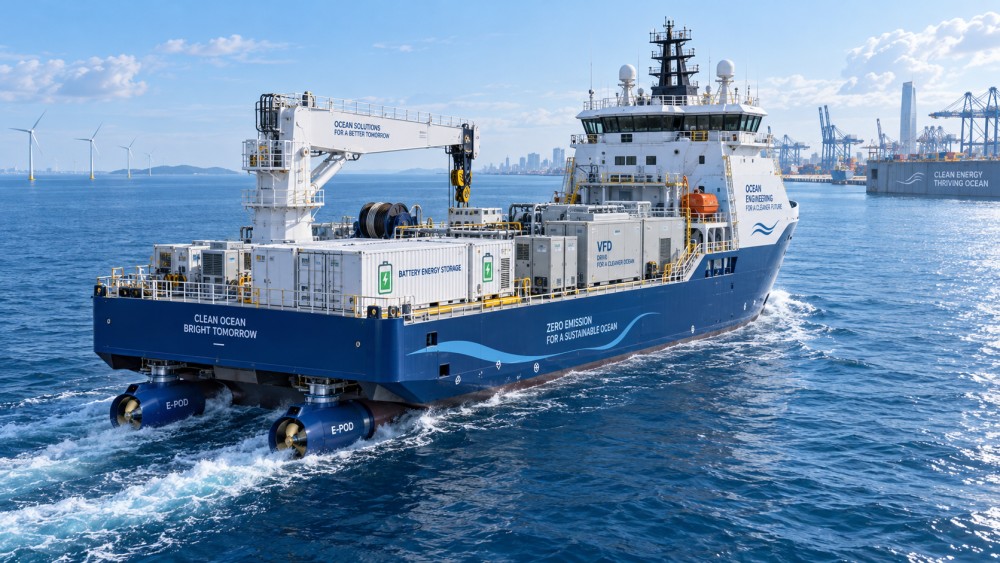
“Blue Power” is a useful umbrella term for marine technologies that improve how energy is produced, distributed, stored, and converted into thrust. This includes variable-frequency drives (VFDs), electric and hybrid propulsion, podded thrusters, battery-supported power systems, shaft generators, advanced power-management systems, and data-led fuel optimization. Their value is most visible on vessels with variable loads, frequent maneuvering, hotel loads, dynamic-positioning demand, or operating patterns that differ sharply from a steady ocean passage.
The short answer: fuel savings depend on the vessel’s energy profile
A conventional propulsion train can be highly efficient when a vessel spends long periods at a stable design speed. But many ships do not live in that ideal condition. Cruise vessels slow down near ports, offshore construction ships hold position for hours, LNG carriers balance cargo-related systems with propulsion demand, and specialized engineering vessels may alternate between transit, standby, lifting, DP operations, and accommodation loads within a single project cycle.
In those conditions, oversized engines and mechanically fixed systems may operate away from their most efficient point. Blue power technologies aim to reduce that mismatch. Rather than forcing machinery to run at a constant speed or with wide safety margins, an integrated electrical system can match available power more closely to the actual demand.
This is why the better question is not “Will electrification save fuel?” but “Where is fuel being lost in this vessel’s real operating profile?” The answer may lie in low-load generator operation, inefficient thruster use, excessive spinning reserve, poor hotel-load management, avoidable idling, or a control system that cannot coordinate machinery fast enough.
Where blue power technologies create fuel-cost reductions
Variable-frequency drives: reducing the penalty of partial load
VFDs allow motors driving pumps, fans, compressors, and propulsion equipment to operate at the speed required by the task, rather than relying on throttling, bypassing, or constant-speed running. This matters because many onboard auxiliary systems spend much of their life below maximum demand.
For seawater cooling pumps, ventilation fans, cargo-related pumping, and certain thruster applications, reducing motor speed can lower electrical demand substantially. The exact outcome depends on the equipment curve and duty cycle, but the principle is straightforward: avoid producing flow, pressure, or thrust that the vessel does not need.
There is also an operational benefit. Smoother motor control can reduce mechanical stress, improve process stability, and make energy consumption more visible to engineering teams. However, retrofit planning must consider harmonic management, cooling requirements, redundancy arrangements, and compatibility with existing switchboards and motors.
Electric propulsion and podded systems: using power more flexibly
Electric propulsion separates prime-mover speed from propeller speed. Generators can be dispatched according to the vessel’s combined demand, while electric motors deliver propulsion power with responsive control. On vessels with fluctuating mission loads, this flexibility can be more valuable than the theoretical efficiency of any individual engine.
Podded propulsion adds maneuverability and can reduce the need for some mechanical components associated with traditional shaft lines and rudders. For luxury passenger ships, ferries, ice-capable vessels, and selected offshore applications, pods may support more precise maneuvering, quieter operation, and improved use of installed power. Their financial case must still be examined carefully: capital cost, maintenance strategy, drydock access, hull integration, and operational redundancy all influence lifecycle value.
Electric propulsion is not automatically the right answer for every deep-sea vessel. A ship that sails at a near-constant speed across long routes may obtain stronger returns from hull optimization, propeller upgrades, engine tuning, weather routing, or waste-heat recovery. The best architecture follows the mission, not the fashion.
Energy-management systems: preventing generators from working against one another
On complex vessels, fuel is often wasted not because an engine is defective, but because the plant is operated conservatively and without sufficiently granular control. A power-management system can monitor load demand, generator efficiency zones, battery state of charge, propulsion needs, and reserve requirements in real time.
When properly configured, it can help determine when to start or stop a generator, when to absorb transient loads through batteries, when to limit non-essential consumption, and how to avoid keeping too many engines online at low load. This is particularly relevant for DP-capable engineering vessels, cruise ships with large hotel loads, and LNG carriers with significant auxiliary demand.
The caution is important: an energy-management platform is only as useful as its operational logic and input data. If sensors are unreliable, load forecasts are poor, or crew members do not trust the system, its potential savings may remain theoretical. Human-machine integration deserves as much attention as the software itself.
Battery hybridization: valuable for peaks, ports, and transitions
Batteries are often discussed as if they must replace all onboard fuel. In practice, their most immediate fuel-saving role may be narrower and more practical. A battery system can shave short-duration power peaks, support spinning reserve, enable quieter port operations, stabilize a variable power grid, and reduce the need to run additional generators solely for transient demand.
For vessels operating frequent port calls, short voyages, offshore standby periods, or dynamic positioning, this can improve generator loading and reduce unnecessary fuel burn. Battery sizing should be based on measured power profiles—not an optimistic brochure scenario. Space, weight, fire protection, thermal management, charging availability, class requirements, and emergency response procedures are central to the decision.
Why the savings are different on cruise ships, LNG carriers, and engineering vessels
Marine energy decisions become more useful when they are vessel-specific. A floating city and a subsea construction vessel may both use electric propulsion, yet their cost drivers are fundamentally different.
For an LNG carrier, fuel-cost analysis cannot be separated from cargo containment, boil-off handling, reliquefaction choices, and propulsion configuration. For a cruise vessel, the guest experience introduces another layer: HVAC, kitchens, lighting, entertainment systems, and hotel services cannot simply be curtailed without consequence. For offshore vessels, redundancy remains non-negotiable, so savings must never compromise station-keeping capability or safety margins.
Can blue power technologies lower a vessel’s fuel costs without creating new operational risks?
They can, provided the project starts with engineering discipline rather than a technology checklist. Electrification changes the way faults propagate, loads are prioritized, and maintenance is planned. A poorly integrated upgrade can introduce power-quality problems, obscure fault diagnosis, or create unacceptable single points of failure. These are not arguments against blue power; they are reasons to design it properly.
A sensible evaluation should address the following questions:
- What are the vessel’s actual load profiles across transit, maneuvering, standby, cargo work, and port operations?
- Which generators spend significant time below their efficient operating range?
- Are propulsion, hotel, process, and mission loads measured separately?
- What redundancy level is required by class, operational risk, and charter commitments?
- Will the proposed system remain serviceable in the vessel’s intended trading areas?
- How will crews be trained to operate, troubleshoot, and override the new control logic safely?
The most successful projects tend to begin with a baseline. Owners need trustworthy data on fuel consumption, engine loading, shaft power, auxiliary demand, weather conditions, route characteristics, and operational events. Without that baseline, it is difficult to distinguish a genuine efficiency gain from a seasonal change in trading pattern or speed.
Common mistakes when assessing marine electrification
Comparing equipment ratings instead of duty cycles. A lower-rated motor or generator is not necessarily a lower-cost solution if it cannot manage real peak conditions. Equally, designing everything around rare peak demand may leave the vessel inefficient for most of its operating life. Duty-cycle analysis bridges that gap.
Assuming fuel savings alone will justify every upgrade. Some investments are supported by several value streams: lower maintenance exposure, improved maneuverability, reduced local emissions, noise reduction, shore-power compatibility, or better compliance resilience. The business case should acknowledge all relevant benefits and costs, including downtime and installation complexity.
Ignoring the electrical network. A new VFD, battery container, or high-power thruster does not exist in isolation. Short-circuit capacity, protection coordination, harmonic distortion, transformer loading, cooling, cable routing, and fault containment need early review.
Making crew adoption an afterthought. Engineers and masters need practical confidence in the system. Clear operating modes, accessible alarms, realistic simulator training, and post-installation support often determine whether a theoretically efficient configuration is used effectively.
A practical path from fuel data to investment decision
Shipowners do not need to commit immediately to a full propulsion conversion. Many fleets can begin with a staged approach. Start by gathering voyage and machinery data over representative operating periods. Identify the largest avoidable energy loads. Then compare operational measures, targeted equipment upgrades, and larger architectural changes on the same lifecycle basis.
For example, a vessel may first gain value from better generator dispatch and VFD control of pumps and fans. A future drydock could provide the window for propulsion upgrades, hull improvements, or battery installation. This sequencing can reduce capital strain while building a clearer evidence base for each next step.
MO-Core follows this broader connection between deep-blue manufacturing and maritime decarbonization: cryogenic systems, electrical integration, exhaust treatment, digital control, and commercial vessel strategy are increasingly linked. A fuel-saving decision in one area can affect machinery redundancy, LNG fuel handling, emissions compliance, procurement planning, and the vessel’s long-term position in a changing charter market.
Frequently asked questions
Do blue power technologies only benefit newbuild vessels?
No. Newbuilds offer more freedom to optimize hull form, machinery layout, cabling, and power architecture from the beginning, but retrofits can still be effective. VFDs, energy-management upgrades, battery hybrid systems, shore-power connections, and selected auxiliary electrification measures are often evaluated for existing tonnage. The practical limit is usually integration complexity, remaining vessel life, and available installation windows.
Will batteries eliminate fuel use on large ocean-going vessels?
Not in every application. Battery systems are especially useful where the operating profile includes short routes, port stays, load peaks, or rapidly changing power demand. For long-distance ocean voyages, batteries may complement rather than replace fuel-based or dual-fuel generation. Their role should be defined by the mission and charging reality.
How quickly can fuel savings appear?
Operational improvements such as generator dispatch, speed management, and control tuning may show effects relatively quickly once data quality and crew practices improve. Major retrofits require longer preparation, class review, procurement, and installation periods. Financial return varies widely with fuel price, utilization, vessel age, operating pattern, and the baseline efficiency of the existing plant.
Are scrubbers and SCR systems part of blue power?
They are not propulsion-efficiency technologies in the same direct sense as VFDs or hybrid power systems, but they are part of the wider decarbonization and compliance picture. Scrubbers and selective catalytic reduction systems address exhaust emissions; an integrated fleet strategy should consider how emissions treatment, fuel choice, electrical demand, and fuel-cost management interact.
Ultimately, blue power technologies can lower vessel fuel costs when they solve a real operational inefficiency rather than merely adding new hardware. The most credible path is measured: understand the vessel’s energy behavior, protect safety and redundancy, test the commercial assumptions, and select technologies that fit the work the ship actually performs. In a market where every voyage carries financial and environmental scrutiny, that level of precision is becoming a competitive advantage.