
Related News
- 00
0000-00
How to Evaluate an Integrated Propulsion Manufacturer for Vessel Retrofit Projects - 00
0000-00
LNG Carrier Price Trends: What Shipbuyers Should Budget for Newbuilds - 00
0000-00
How to Evaluate Marine Semiconductor Suppliers for Shipboard Reliability - 00
0000-00
How Dual-Fuel Ships Cut Emissions Across Different Fuel and Operating Profiles - 00
0000-00
How to Select Low-Voltage Marine Drives for Electric Propulsion Below 1 kV

Even as LNG demand expands, the LNG transport chain continues to face bottlenecks that directly affect equipment lead times, project scheduling, and procurement risk. For buyers navigating shipbuilding and marine energy projects, understanding where delays still originate—from cryogenic components to logistics coordination—has become essential for smarter sourcing decisions, cost control, and stronger supply chain resilience.
Why scenario differences matter more than general market headlines
For procurement teams, broad statements such as “the market is tight” are no longer useful enough. The real issue is that bottlenecks inside the LNG transport chain do not hit every project in the same way. A new LNG carrier program, an FSRU retrofit, a dual-fuel engine package, and a shore-side bunkering project can all face delays, but the root causes differ. In one case, the problem may be membrane-related components and specialized valves; in another, it may be electrical integration, testing slots, or export logistics for oversized skids.
This is why buyers should evaluate the LNG transport chain through application scenarios rather than industry averages. The same lead-time headline may hide very different risks for containment systems, cryogenic pumps, boil-off gas handling units, automation cabinets, stainless piping packages, or SCR and scrubber interfaces linked to broader vessel compliance programs. Scenario-based judgment allows purchasing teams to decide whether to lock capacity early, qualify alternate suppliers, or redesign package scope before the project schedule is exposed.
Where the LNG transport chain still creates lead-time pressure
Although supply conditions have improved compared with the most severe disruption periods, several bottlenecks still shape lead times across the LNG transport chain. These constraints matter because they are cumulative: one late subcomponent can hold back factory acceptance, transport planning, onboard installation, and sea-trial sequencing.
- Limited manufacturing capacity for cryogenic valves, pumps, heat exchangers, and insulation-critical components.
- Long approval cycles for highly engineered packages requiring classification review, owner comments, and yard coordination.
- Dependence on specialty materials such as nickel alloys, stainless grades, sealing materials, and low-temperature electrical parts.
- Testing and certification congestion, especially for FAT windows, low-temperature performance validation, and integrated control systems.
- Transport complexity for large modules that need route planning, export documents, and synchronized delivery to shipyards.
For marine projects, these issues rarely appear in isolation. MO-Core’s intelligence perspective is especially relevant here: buyers in high-value shipbuilding often face multi-disciplinary dependencies between cryogenic fluid handling, electrical propulsion interfaces, emissions compliance equipment, and yard production slots. In other words, the LNG transport chain is not only a cargo issue; it is a system-integration issue.
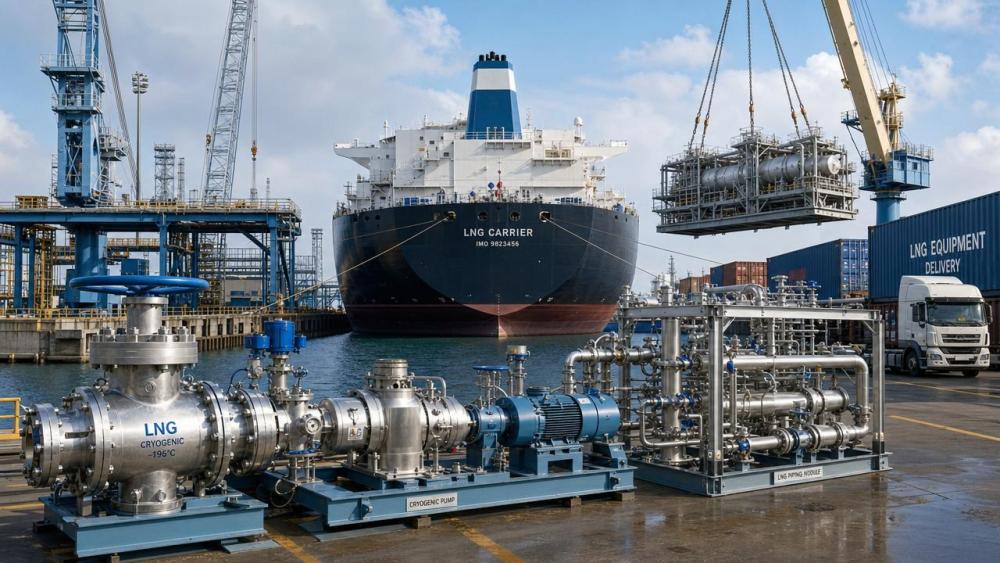
Typical procurement scenarios and how bottlenecks show up differently
A practical way to assess the LNG transport chain is to map bottlenecks against project type. The table below helps procurement personnel see where lead-time pressure usually comes from and what to verify first.
Scenario 1: Newbuild LNG carriers need early locking, not late negotiation
In a newbuild LNG carrier program, the LNG transport chain affects lead times most heavily through specialized package concentration. A relatively small pool of qualified suppliers often serves a large share of the market. That means procurement teams are not just buying equipment; they are competing for engineering bandwidth, test capacity, and delivery windows.
The most common mistake in this scenario is delaying technical freeze in hopes of improving commercial terms. For highly engineered cryogenic systems, late specification changes usually cost more than they save. Valve trim revisions, sensor list updates, control logic additions, or material documentation changes can push drawings back through class and owner review, which then shifts manufacturing release. In the LNG transport chain, documentation delay is often production delay in disguise.
Buyers in this scenario should focus on milestone discipline: design approval dates, long-lead subcomponent reservation, FAT scheduling, packing method, and shipyard-required delivery sequence. These controls reduce the chance that one missing cryogenic item will disrupt block erection or cargo system completion.
Scenario 2: Retrofit and conversion projects face hidden interface bottlenecks
For FSRUs, carrier conversions, or fuel system retrofits, the LNG transport chain is less about pure factory capacity and more about engineering uncertainty. Existing vessel arrangements, legacy cable routes, nozzle positions, structural limits, and operating constraints can all trigger redesign. In this scenario, the lead time problem often starts after the order is placed, not before.
Procurement teams should therefore ask a different set of questions. Is the supplier quoting against a mature model or a preliminary layout? Are low-temperature supports, insulation details, and electrical interfaces fully defined? Has the yard reserved lifting and installation access? If not, the LNG transport chain may appear stable on paper while the actual project remains exposed to repeated revisions.
A useful strategy in retrofit scenarios is to separate “must-freeze” items from “field-adjustable” items. Long-lead equipment should be tied to the most stable parameters first, while brackets, secondary supports, and non-critical spool details can remain flexible. This approach protects schedule without pretending that every interface can be finalized early.
Scenario 3: LNG bunkering and small-scale projects suffer from coordination gaps
Small-scale LNG projects are often assumed to be easier because package sizes are smaller. In practice, the LNG transport chain can be just as vulnerable because project teams may underestimate coordination needs. Bunkering vessels, satellite terminals, and distributed fueling assets depend on precise alignment between transfer equipment, safety systems, automation logic, and local regulatory acceptance.
In these projects, the bottleneck is frequently cross-supplier synchronization. One vendor may be ready to ship, while another has not finalized control signal mapping or ESD logic. The result is not always a visible manufacturing delay; instead, it appears as commissioning slippage, on-site rework, or partial delivery that creates storage and handling risks. For buyers, this means the LNG transport chain should be assessed as a package ecosystem, not as a list of independent purchase orders.
Different buyers, different risk signals
Procurement decisions also vary by organization type. A shipyard buyer, an owner’s technical purchasing team, and an EPC package manager may all look at the same LNG transport chain and see different warning signs.
- Shipyards should focus on delivery sequence, preservation requirements, installation readiness, and onboard labor peaks.
- Owners and operators should focus on lifecycle support, spare parts access, service response, and consistency across fleet assets.
- EPC and integrators should focus on document control, interface matrices, module transport, and testing dependencies across vendors.
Understanding this difference matters because a low price can still be high risk if it comes with thin engineering support, limited aftermarket capability, or weak visibility into upstream sub-suppliers. In the LNG transport chain, transparency is often as valuable as nominal capacity.
How to judge whether a supplier is truly suitable for your scenario
Instead of asking only for quoted lead time, buyers should verify whether the supplier’s operating model fits the application. A credible supplier for one LNG transport chain scenario may be a poor fit for another.
- Ask what portion of the package is manufactured in-house versus sourced from long-lead partners.
- Confirm actual capacity reservation rules, not just standard catalog lead times.
- Check whether FAT slots are fixed, shared, or vulnerable to previous-project spillover.
- Review experience in the same vessel type or terminal configuration, not only in LNG generally.
- Evaluate logistics support for export packing, moisture protection, shock control, and destination handling.
This scenario-fit method is especially useful in high-value marine sectors where electrical propulsion systems, containment equipment, and emissions solutions often compete for yard attention at the same time. MO-Core’s sector view suggests that procurement resilience increasingly depends on cross-package planning, not single-vendor optimization.
Common misjudgments that still create avoidable delays
Several recurring mistakes continue to extend lead times in the LNG transport chain. The first is treating all LNG-related equipment as equally critical. In reality, some items are commercially sensitive but easy to replace, while others are technically small yet schedule-critical because they block testing or safety approval.
The second misjudgment is believing that a confirmed factory completion date equals project readiness. If transport booking, customs documents, preservation instructions, or site receiving plans are weak, finished equipment can still miss the real installation window. The third is underestimating the effect of approval loops. Owner comments, class clarifications, and shipyard interface revisions can consume more time than fabrication itself.
Finally, many teams monitor only direct suppliers. In the LNG transport chain, hidden upstream exposure is common. A system assembler may look healthy while depending on a constrained sub-supplier for actuators, transmitters, forged bodies, or specialist insulation materials. Procurement teams should ask where the true bottleneck sits, not just who issued the quotation.
FAQ for procurement teams managing LNG transport chain exposure
Should buyers always place orders earlier?
Not always. Early ordering helps when specifications are mature and the LNG transport chain bottleneck is capacity-driven. If engineering is still unstable, premature ordering can trigger costly change cycles. The better rule is to lock high-risk, long-lead items once key interfaces are credible.
Which projects are most sensitive to LNG transport chain delays?
Newbuild LNG carriers and conversion projects are usually the most sensitive because they combine specialized equipment with complex approvals. However, bunkering and small-scale LNG assets can also be highly vulnerable when coordination resources are limited.
What is the best early warning indicator?
A widening gap between quoted lead time and drawing approval status is one of the strongest warning signs. If the LNG transport chain is already tight, unresolved documents usually mean the official delivery date is less secure than it appears.
Turning scenario insight into stronger sourcing action
For procurement professionals, the LNG transport chain should be managed as a scenario-specific risk map rather than a generic market condition. Newbuilds need early capacity locking. Retrofits need interface discipline. Small-scale projects need tighter coordination. Across all scenarios, the best results come from matching sourcing strategy to the actual bottleneck—manufacturing, approvals, materials, testing, or logistics.
If your organization is evaluating LNG carrier gear, fuel gas systems, cryogenic packages, or integrated marine energy solutions, the next step is to review your project by scenario: which items are truly long-lead, which interfaces are still fluid, and which suppliers can prove resilience beyond the quotation sheet. That is where better procurement decisions begin, and where the LNG transport chain becomes manageable instead of disruptive.