
Related News
- 00
0000-00
Energy-Efficient Ship Design: Matching Hull and Propeller to Service Speed - 00
0000-00
Modeling Cryogenic Tank Sloshing: When Does Phase Change Matter in CFD? - 00
0000-00
Choosing Heavy-Lift Crane Vessels for Offshore Projects: Capacity and Outreach - 00
0000-00
Choosing a Ship Component Availability Database: Stock Accuracy and Lead Times - 00
0000-00
How Low-Carbon Navigation Systems Optimize Ship Routes to Reduce Fuel Use

Port decarbonization news changes terminal upgrade priorities when it alters a condition that was previously treated as fixed: the expected vessel mix, the emissions exposure during berth calls, the available electrical capacity, or the acceptable operating window for fuel-handling equipment. The practical consequence is rarely an immediate need to replace every diesel asset. It is a need to re-rank projects before design packages, utility agreements, and procurement commitments lock a terminal into infrastructure that no longer fits the direction of vessel operations.
The strongest signals are those that connect a policy or technology development to a physical constraint at the terminal. News of expanding shore-power requirements, for example, matters differently at a cruise berth with long hotel-load demand than at a container berth with short calls and irregular vessel compatibility. An announcement about alternative-fuel vessel orders has a different implication where bunkering is already part of terminal traffic than where the port has limited exclusion zones, constrained road access, or no practical marine transfer route. Treating each headline as a universal mandate creates expensive sequencing errors.
Read the signal behind the headline
Port decarbonization news often arrives in broad language: lower emissions, clean berth operations, electrified equipment, cleaner fuels, or digital energy management. Before assigning a capital response, separate the signal into four questions: which emission source is affected, where the source operates, what technical interface is required, and when the condition could influence terminal access or operating cost.
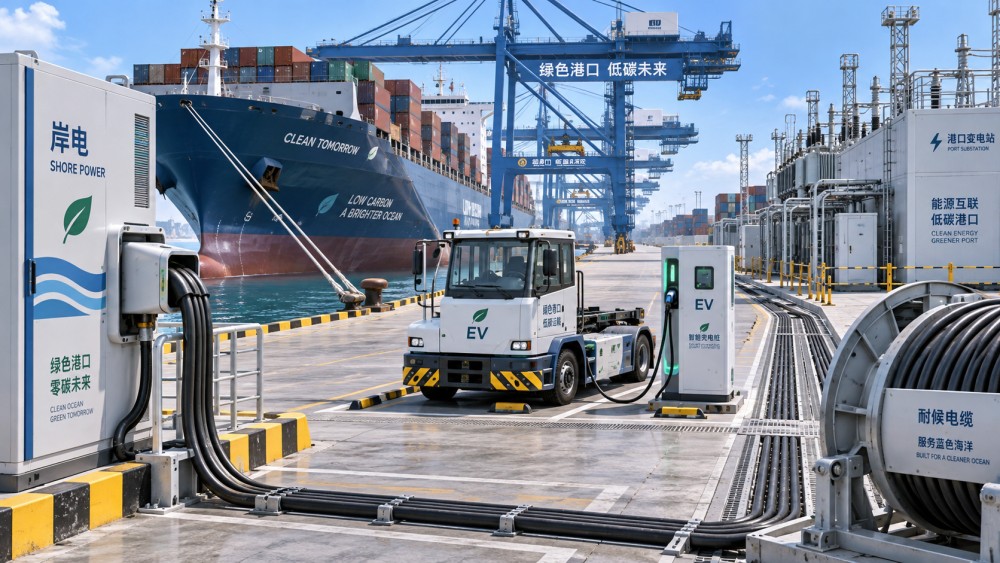
At berth, shore power addresses auxiliary-engine emissions only when a vessel is equipped to receive the local supply and the connection can be completed without disrupting cargo work. A terminal may have high vessel-call volumes but limited shore-power utilization if arriving ships use incompatible voltage or frequency arrangements, have cable-management systems on different sides, or cannot maintain safe access around loading arms, gangways, or container operations. The headline may justify protecting space and cable routes in a current project, while full electrical installation remains premature until vessel compatibility is clearer.
Electrification news around cargo handling should be read through duty cycle rather than asset count. A rubber-tyred gantry, terminal tractor, reach stacker, or mobile harbor crane does not impose the same charging pattern. Some equipment can charge during predictable pauses. Others need high availability through peak gate periods or vessel exchanges, which shifts attention from charger quantity to feeder capacity, battery exchange logistics, thermal management, and dispatch rules. Replacing visible diesel machines without redesigning the operating pattern can simply move delay and emissions exposure upstream into temporary generators or grid peaks.
Developments involving LNG, methanol, ammonia, hydrogen, or battery-supported vessels deserve the same discipline. Fuel announcements do not automatically justify a terminal-side fuel facility. The relevant question is whether the terminal must handle the fuel, accommodate a vessel using it, or merely coexist with bunkering activity nearby. Those are materially different scopes. Handling creates requirements for transfer interfaces, hazardous-area classification, emergency isolation, spill and vapor management, operator procedures, and separation from cargo movements. Accommodation may require only revised berth rules, emergency coordination, and protected clearances.
Priorities should follow operational exposure
A useful upgrade order begins with the emissions sources that combine high exposure, a feasible intervention, and a dependency that needs early protection. This places enabling works ahead of highly visible equipment in many terminals. Duct banks, transformer pads, switchgear rooms, cable trenches, structural allowances, utility corridors, and communications pathways are difficult to add after pavements, quay aprons, or buildings are complete. Their early inclusion preserves options even if the final technology choice remains open.
Quay-side electrical work illustrates the distinction. Shore power is often discussed as a berth appliance, but its feasibility begins farther inland. The project must establish the incoming supply capacity, fault level, transformer configuration, harmonics performance, power-quality responsibilities, metering boundary, and backup philosophy. Long cable runs create voltage-drop and handling considerations. Salt-laden air, splash zones, vessel motion, and repeated connection cycles influence enclosure ratings, connector design, cable insulation, reel selection, and maintenance access. A shore connection that works in an equipment demonstration can still be impractical if cable deployment interferes with mooring lines, passenger movement, crane rails, or cargo hoses.
For cargo equipment, the first priority may be a power and traffic study rather than an immediate fleet conversion. Map each asset by route, idle time, shift overlap, load profile, and recovery location. A tractor pool serving a compact yard may support centralized charging. The same fleet serving remote inspection areas and high-turnaround gates may require distributed chargers, opportunity charging, or a mixed fleet through the transition period. Battery capacity alone is a weak selection criterion because usable energy changes with ambient temperature, payload, gradient, auxiliary loads, charging behavior, and battery aging.
Digital energy monitoring belongs near the start of the sequence when load growth is uncertain. Metering at the utility intake is insufficient for diagnosing berth loads, charging clusters, reefer banks, workshops, and building demand. Sub-metering should follow operational boundaries that can be acted upon. A system that only produces a total consumption figure cannot reveal whether a peak came from simultaneous crane movements, a poorly timed charging cycle, refrigeration demand, or a shore-power connection. Granular data supports tariff analysis, maintenance investigation, and control logic, but its value depends on reliable equipment tags, timestamp synchronization, and a clear owner for data quality.
Distinguish replacement projects from system projects
Decarbonization upgrades are frequently underestimated because a component purchase is mistaken for a system change. A battery-electric terminal tractor involves chargers, network capacity, parking layout, maintenance bays, fire response arrangements, spare-unit planning, and software integration with dispatch routines. Shore power involves vessel interfaces, utility coordination, berth geometry, operating procedures, and commercial allocation of electricity costs. Exhaust-treatment changes involve washwater arrangements, reagent handling where relevant, drainage compatibility, corrosion resistance, and sampling or monitoring interfaces.
This distinction matters when port decarbonization news creates pressure for rapid action. A terminal can move quickly on actions with reversible or reusable value: reserve electrical space, install conduits, deploy temporary metering, update procurement specifications, and require communication interfaces in new equipment. It should move more cautiously where the selected technology fixes a long-lived layout or commits the site to a particular fuel pathway. Quay modifications, large substations, permanent fuel-transfer systems, and high-capacity charging yards are hard to relocate once operational constraints become visible.
Design freeze should wait for the missing interface data
The most costly errors usually occur at interfaces between terminal infrastructure and moving assets. A berth design can be advanced to a high level of confidence before every vessel is known, but final connection arrangements need verified data: receiving-voltage range, frequency, maximum and typical load, connection-side location, cable reach, vessel access restrictions, and changeover sequence. Assuming the nameplate electrical rating represents normal berth demand can oversize upstream equipment and distort the business case. Assuming it represents a peak that will never occur can create nuisance trips and operational restrictions.
Similar gaps arise in electrified yard projects. Charger ratings do not directly equal site demand because charging events overlap unevenly. Yet diversity factors should not be applied casually. The relevant overlap is shaped by vessel schedules, shift handovers, weather disruption, equipment dispatch rules, and recovery charging after congestion. A load model needs credible operational scenarios, including the exceptional periods when the terminal is under pressure. The grid connection, transformer, protection settings, and energy-management controls should be tested against those scenarios before construction packages are released.
Materials and installation details deserve attention early because marine environments expose weak assumptions quickly. Cable supports and enclosures require corrosion protection suited to their actual location, not simply a generic outdoor specification. Stainless-steel selection, coating system, drainage, dissimilar-metal isolation, gland sealing, and access for inspection affect lifecycle performance. Underground routes need coordination with drainage, foundations, firefighting lines, rail tracks, and future civil works. In congested terminals, an unprotected duct crossing can become the reason that a later charger or shore-power expansion requires pavement demolition.
Compliance risk is often a schedule risk first
Regulatory developments influence terminal projects before a final legal obligation takes effect. They alter the assumptions used by lenders, insurers, vessel operators, utilities, and local authorities. The immediate exposure is often schedule uncertainty: a project designed around current operations may be challenged during permitting, delayed by revised utility studies, or forced to add monitoring and emergency provisions after construction has started.
Early engagement should therefore focus on specific interfaces rather than broad declarations of environmental intent. Utility discussions need anticipated load profiles, phased demand, power-quality expectations, and a realistic energization date. Marine authorities need clarity on berth access, segregation, emergency shutdown, and vessel movements. Fire and safety reviews need the actual equipment layout, battery or fuel inventory boundaries, drainage paths, and isolation points. Vague future-proofing language is less useful than a drawing showing where the next feeder, emergency stop, or protected route can be installed.
Scrubber and selective catalytic reduction developments should also be interpreted with care. These technologies may reduce certain shipboard exhaust pollutants, but they do not eliminate a terminal's need to address berth emissions, local air-quality concerns, or electrical infrastructure planning. Their main terminal implications can be indirect: waste-handling arrangements, washwater considerations where applicable, service access, and vessel acceptance policies. Treating them as substitutes for shore power without matching the local compliance objective creates a false comparison.
Use phased packages without creating stranded work
A phased approach works when each stage delivers a usable operational result or preserves a defined future option. Phase one may concentrate on data capture, utility capacity confirmation, civil reservations, and equipment specifications that require open communication protocols. Phase two can target the berth, equipment pool, or refrigeration zone where utilization and emissions exposure are both material. Later stages should be triggered by evidence such as confirmed vessel retrofits, sustained electrical-load patterns, signed route commitments, or an approved utility connection.
Phasing fails when it fragments a system across incompatible assumptions. Installing chargers before confirming transformer capacity, building a shore-power room before vessel cable geometry is known, or specifying alternative-fuel space without access and emergency isolation routes can leave expensive assets underused. Each package should state its design basis, interfaces left open, assumptions that must be revalidated, and the consequence if the next phase is delayed.
Port decarbonization news is most valuable when it is converted from a general market signal into a short list of changed assumptions. That translation keeps upgrade priorities tied to berth operations, utility constraints, equipment duty cycles, and construction sequencing. The result is a terminal program that can respond to new emissions expectations without committing capital to infrastructure that the operating reality cannot support.