
Related News
- 00
0000-00
How to Evaluate an Integrated Propulsion Manufacturer for Vessel Retrofit Projects - 00
0000-00
LNG Carrier Price Trends: What Shipbuyers Should Budget for Newbuilds - 00
0000-00
How to Evaluate Marine Semiconductor Suppliers for Shipboard Reliability - 00
0000-00
How Dual-Fuel Ships Cut Emissions Across Different Fuel and Operating Profiles - 00
0000-00
How to Select Low-Voltage Marine Drives for Electric Propulsion Below 1 kV

For financial approvers, the biggest mistake in budgeting for dual-fuel integration is assuming the overrun will come from the fuel tanks or engines alone. In practice, budgets usually go off track because cost growth is distributed across design revisions, cryogenic handling, electrical integration, class and flag compliance, yard coordination, and schedule disruption. The headline equipment is visible; the integration burden is not.
The core search intent behind this topic is practical and risk-focused: decision-makers want to know where dual-fuel projects most often exceed budget, why early estimates fail, and how to evaluate proposals before committing capital. They are not looking for a generic technical overview. They want a clearer basis for approval, challenge, and control.
For financial approvers, the most important questions are straightforward. Which cost items are usually underestimated? Which project assumptions are most fragile? At what stage do changes become expensive? And how can a budgeting process distinguish a disciplined integration plan from an optimistic one?
This article addresses those concerns directly. Rather than treating all cost categories equally, it focuses on the budget areas that most often drift, the warning signs that appear early, and the approval logic that helps organizations reduce unpleasant surprises.
Why dual-fuel integration budgets look reasonable early and then deteriorate later
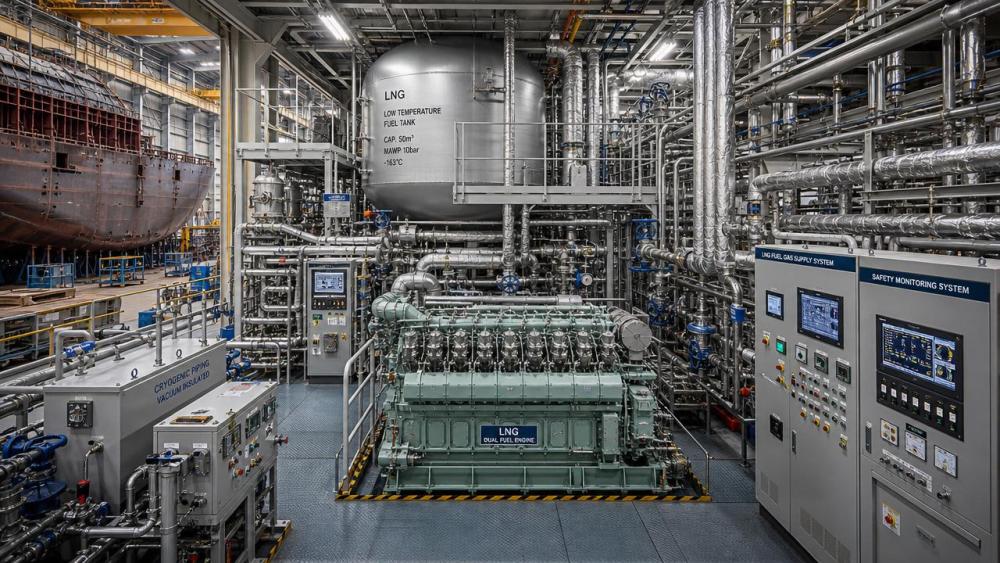
On paper, a dual-fuel conversion or newbuild integration can appear manageable because the first estimate usually centers on major hardware: engines, tanks, fuel gas supply systems, ventilation, controls, and safety systems. Those line items are tangible, vendor-quoted, and easier to benchmark. The problem is that financial exposure rarely sits only in the equipment list.
Once detailed engineering begins, the project becomes an exercise in system interaction. Tank placement affects cargo or accommodation layouts. Cryogenic pipe routing changes insulation, support structures, and hazardous area boundaries. Electrical load reviews trigger switchboard, cable, converter, or automation modifications. Compliance requirements create additional instrumentation, shutdown logic, and testing scope. Each change may look isolated, but together they shift both capital cost and schedule risk.
For finance teams, the key insight is this: dual-fuel integration is less a procurement exercise than a cross-disciplinary coordination project. Budgets go off track when early estimates capture components but fail to price the engineering complexity required to make those components function safely, efficiently, and compliantly within the vessel.
The cost categories most likely to be underestimated
The first category is engineering and redesign. Initial estimates often assume that concept design is close to final design. In reality, dual-fuel integration can trigger repeated revisions across naval architecture, structural engineering, piping, ventilation, electrical systems, automation, fire safety, and evacuation arrangements. On high-value ships, even a small change to layout can cascade into expensive rework.
The second category is cryogenic infrastructure. LNG and other low-temperature fuel systems are not simply “extra piping.” They require specialized materials, insulation, pressure management, boil-off considerations, leak detection, ventilation strategy, and hazardous zone treatment. Budget plans that account for tanks but not the full cryogenic ecosystem almost always understate total installed cost.
The third category is electrical and control system integration. Financial models often treat this as a secondary package, yet it is a common source of overrun. Dual-fuel operation demands reliable interlocks, control logic, gas detection interfaces, emergency shutdown systems, alarm management, redundancy validation, and commissioning effort. If legacy electrical architecture is not prepared for these demands, hidden upgrade costs emerge late.
The fourth category is compliance and approval. Class, flag, port-state expectations, IMO emissions rules, and owner-specific safety standards can all expand project scope. Additional documentation, model reviews, HAZID or HAZOP sessions, software validation, material certification, and testing may not look dramatic in early capex discussions, but they consume both money and schedule.
The fifth category is installation disruption. In a live shipyard or retrofit environment, space conflicts, access restrictions, contractor sequencing, and production interference increase labor cost quickly. A budget can be technically correct and still commercially wrong if it assumes ideal installation conditions that do not exist.
Where financial forecasts usually become unreliable
Forecasts become unreliable when too many assumptions remain untested. One common failure point is layout certainty. If tank location, machinery room interfaces, and pipe routing are not frozen early, any cost estimate should be treated as directional rather than approval-grade. A vessel may technically support dual-fuel integration, but commercial viability depends on how much displacement, usable volume, and operational flexibility are sacrificed.
Another weak point is vendor boundary definition. Financial approvers often receive proposals in which responsibility between engine supplier, tank supplier, automation vendor, integrator, and yard is not fully aligned. Gaps between packages later become owner costs. Conversely, overlaps can create duplicate contingency and inflated pricing. In both cases, the forecast is distorted.
Schedule assumptions are also a major source of error. If the budget assumes normal procurement lead times for specialized cryogenic valves, insulation materials, control hardware, or approved steelwork, it may be outdated before the project starts. In marine projects, schedule delay is not just a timing issue. It often triggers labor inefficiency, contract variation, delayed revenue service, and financing pressure.
Finally, reliability weakens when commissioning is under-scoped. Sea trials, gas trials, control logic tuning, crew familiarization, and safety validation are sometimes treated as minor close-out activities. In reality, commissioning can become a major cost center, especially when systems from different vendors do not integrate cleanly on the first pass.
The hidden multiplier effect of late-stage changes
Financial approvers should pay close attention to timing because the same technical issue becomes far more expensive if discovered late. A ventilation concern identified during concept design may require a manageable routing adjustment. The same concern identified after fabrication can mean rework, delay, retesting, and contract claims. This is why dual-fuel budgets often appear stable for months and then move sharply in a short period.
Late-stage changes are especially costly in three areas. The first is structural modification, where support foundations, penetrations, and compartment arrangements must be altered after steelwork or outfitting has advanced. The second is software and controls, where an overlooked logic dependency can expand into system-wide retesting. The third is compliance documentation, where approval comments from class or flag may reopen work that the project team assumed was complete.
For finance leaders, this creates a useful rule: the later the uncertainty, the larger the contingency needed. If a project is seeking approval while key interfaces remain unresolved, the investment case should be stress-tested against late-stage change scenarios rather than best-case execution.
How to judge whether a dual-fuel budget is genuinely credible
A credible budget for dual-fuel integration is not defined by how detailed the headline capex number looks. It is defined by how clearly the proposal explains interfaces, assumptions, exclusions, and change-control logic. Financial approvers should ask whether the estimate reflects concept-level optimism or execution-level discipline.
Start with scope maturity. Has the project team progressed beyond a technology decision into actual integration planning? A serious budget should show preliminary layout certainty, identified hazardous zones, utility impacts, class engagement status, and a realistic view of installation sequence. If these elements are absent, cost confidence is low regardless of how polished the spreadsheet appears.
Next, examine contingency structure. A well-built budget does not hide uncertainty in a single percentage. It separates technical contingency, schedule contingency, and commercial contingency. This matters because the mitigation tools differ. Technical uncertainty is reduced by engineering. Schedule uncertainty is reduced by procurement and planning. Commercial uncertainty is reduced by contract clarity and vendor alignment.
Then assess interface ownership. Someone must own the integration risk between cryogenic systems, propulsion controls, electrical architecture, structural work, and compliance approvals. If responsibility is fragmented without a strong systems integrator or experienced yard coordination, the finance case should reflect a higher probability of change orders.
Finally, test the operating case, not just the installation case. Some proposals justify cost through fuel flexibility, emissions compliance, and lifecycle efficiency, but the benefit assumptions depend on route profile, bunkering access, utilization rate, and maintenance capability. A financially sound approval process should challenge both sides of the equation: capex realism and operational payback realism.
Questions financial approvers should ask before signing off
Several questions quickly reveal whether a proposal is robust. What percentage of the estimate is based on firm vendor input versus placeholders? Which design packages are still open? What class or flag comments are expected but not yet incorporated? What portion of installation labor assumes ideal yard productivity? Which systems require software integration across multiple vendors?
Approvers should also ask what is not included. Exclusions often tell a more useful story than inclusions. If training, commissioning support, spare parts, software revisions, insulation rework, gas trials, or temporary operational constraints are excluded, the “approved budget” may only represent the first layer of spending.
Another valuable question is whether the project team has modeled downside scenarios. What happens if tank placement reduces revenue-generating space? What if procurement slips by twelve weeks? What if additional gas safety upgrades are required after design review? Approval decisions improve when downside economics are visible before commitment rather than explained afterward.
How organizations can keep dual-fuel integration costs under control
The most effective cost control measure is earlier engineering maturity before final budget approval. This does not mean waiting for every drawing to be complete. It means funding enough front-end design to expose major clashes, compliance issues, and installation constraints before the capex number is locked into internal expectations.
The second measure is disciplined interface management. Dual-fuel projects involve specialist suppliers who may optimize their own package without optimizing the vessel-level outcome. A strong integration lead, clear workshare matrix, and formal responsibility mapping reduce the number of expensive surprises that otherwise fall back on the owner.
The third measure is stage-gated approval. Instead of treating the project as a single go/no-go event, organizations can approve concept, front-end engineering, and execution in separate steps with defined confidence thresholds. This approach is often more finance-friendly because it prevents management from overcommitting capital before uncertainty has been properly reduced.
The fourth measure is realistic contingency governance. Contingency should not be viewed as a negotiating embarrassment or evidence of poor planning. In dual-fuel integration, it is a recognition of genuine complexity. The discipline lies in making contingency visible, assigning triggers for release, and tracking its consumption transparently.
Final takeaway for budget owners
When dual-fuel integration costs go off track, the root cause is usually not one dramatic equipment surprise. It is the cumulative effect of underestimated engineering effort, unresolved system interfaces, compliance expansion, electrical and cryogenic complexity, and late-stage change. For financial approvers, that means the right question is not simply, “How much does dual-fuel integration cost?” but, “How mature and controllable is this integration plan?”
A strong investment decision comes from recognizing that integration quality drives budget reliability. If the scope is mature, interfaces are owned, assumptions are explicit, and contingencies are structured, the project can be judged with confidence. If those conditions are missing, the most attractive headline budget may be the least trustworthy one.
In a market shaped by decarbonization, fuel flexibility, and increasingly strict marine compliance, dual-fuel integration can be strategically valuable. But for finance leaders, value is created only when technical ambition is matched by budgeting discipline. That is where better approvals begin—and where fewer projects go off track.