
Related News
- 00
0000-00
Green Energy Sea Delivered as China’s Largest LNG Carrier Project Reaches Eight Ships - 00
0000-00
Buying Marine Drives in North America: Lead Times, Parts, and Service - 00
0000-00
QatarEnergy-Controlled LNG Carrier Appears to Attempt Rare Suez Transit - 00
0000-00
Digital Shipbuilding in Southeast Asia: Which Upgrades Should Shipyards Prioritize? - 00
0000-00
What Drives Pipe-Laying Vessel System Prices? Equipment and Integration Costs
Tags
- Deep-blue Manufacturing
- Maritime Decarbonization
- electrical integration
- marine electric propulsion
- SCR systems
- LNG carriers
- shipbuilding
- podded propulsion
- marine intelligence
- marine engineering
- selective catalytic reduction
- dual-fuel engines
- Does selective catalytic reduction meet current IMO NOx rules?

Does Selective Catalytic Reduction Meet Current IMO NOx Rules?
Yes—selective catalytic reduction (SCR) can meet current IMO NOx requirements, including IMO Tier III limits, when it is correctly specified, installed, calibrated, and operated as part of an approved engine-emissions arrangement. But that answer needs a few qualifiers. An SCR reactor is not a universal compliance badge, and fitting one to a vessel does not automatically make every operating condition compliant.
The real question is usually more practical: does the engine need Tier III compliance, in which geographical area, at what load profile, and with what verification path? Those details matter especially on vessels with variable duty cycles—offshore construction ships, cruise vessels, LNG carriers, and electrically integrated ships whose main engines may not always run at their design point.
For the marine sector, SCR remains one of the most established routes to substantial nitrogen oxide reduction. It is widely understood by engine builders, class societies, yards, and operators. Yet it also introduces space, temperature, urea-handling, maintenance, and control-system questions that should be addressed early in a newbuild or retrofit project.
What the IMO NOx Rules Actually Require
Marine NOx limits are set under Regulation 13 of MARPOL Annex VI. The applicable limit depends principally on the engine’s rated speed, the ship’s construction date, and where the ship operates. IMO rules distinguish among Tier I, Tier II, and Tier III standards. Tier III is the strictest level and applies to certain marine diesel engines when a vessel operates inside designated NOx Emission Control Areas, commonly called NECAs.
The North American and United States Caribbean Sea NECAs apply Tier III requirements to ships constructed on or after 1 January 2016, subject to the regulation’s scope and stated exemptions. In the Baltic Sea and North Sea NECAs, Tier III applies to ships constructed on or after 1 January 2021 when operating in those areas. A vessel may therefore operate under Tier II expectations outside a NECA but need Tier III performance upon entry into one.
This geographic distinction is frequently misunderstood. Tier III is not a blanket requirement for every ship worldwide, nor is it simply a port rule. It is linked to the vessel, the engine, the construction-date provisions, and the relevant operating area. The engine’s EIAPP certification and the approved NOx Technical File remain central documents. For a specific project, the final reading should always be checked against the applicable flag, class, engine-maker documentation, and current IMO text.
IMO describes Tier III as representing an approximately 80% reduction in NOx emissions compared with the Tier I level. Achieving that reduction generally calls for more than basic in-cylinder tuning. This is where SCR has become a practical option.
Why SCR Is Capable of Tier III Compliance
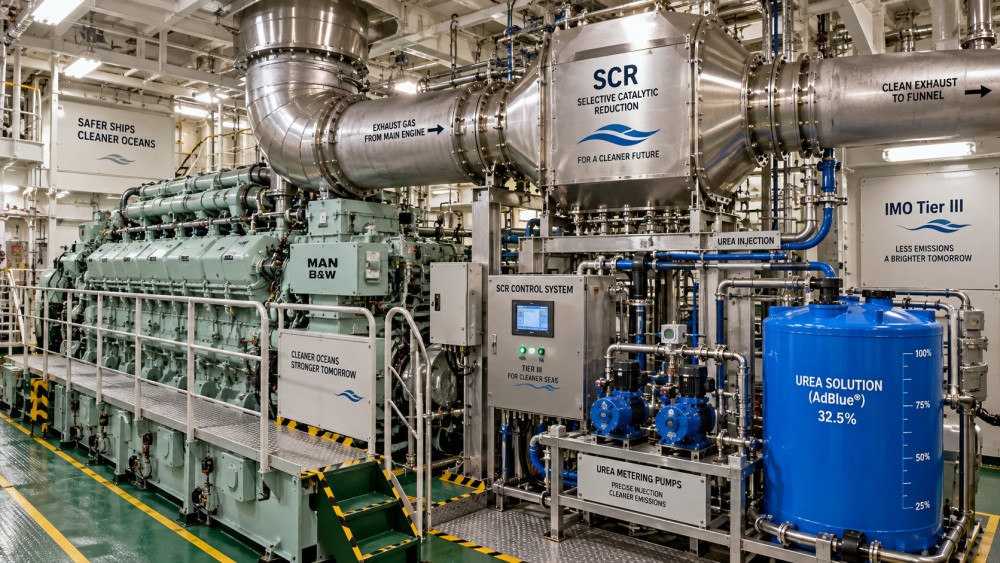
SCR treats exhaust gas after combustion. A urea-based reducing agent is injected into the exhaust stream, where it forms ammonia under the right thermal conditions. Inside the catalyst, ammonia reacts with nitrogen oxides and converts them primarily into nitrogen and water. The chemistry is well established; the marine engineering challenge lies in making it work reliably across the vessel’s actual operating profile.
When an SCR system is selected by the engine manufacturer or integrated within an approved emissions-control package, it can reduce NOx sufficiently to support Tier III certification. In many applications, particularly medium- and high-speed four-stroke engines, it has become a familiar compliance route. It may be installed upstream or downstream of certain exhaust components depending on the engine and fuel arrangement, but the configuration should never be treated as interchangeable.
The phrase “can meet” is important. Compliance is demonstrated through the certified engine arrangement and its approved settings, not by a reactor vessel alone. Catalyst volume, urea dosing logic, exhaust temperature, mixing quality, backpressure, sensors, and control interfaces all affect the result. A system that performs well during a formal test must also be kept within its approved operational envelope over time.
The Operating Conditions That Can Make or Break SCR Performance
SCR systems need sufficient exhaust-gas temperature to initiate and sustain effective chemical conversion. That sounds straightforward until the vessel’s load profile is examined. A main engine on a long-distance transit may provide stable exhaust conditions. A DP vessel holding position offshore, a cruise ship maneuvering frequently, or a hybrid vessel running generators at low load can present a very different picture.
At low exhaust temperatures, urea injection may need to be limited or delayed to avoid deposits and incomplete conversion. Conversely, poor dosing control can create ammonia slip—excess ammonia leaving the catalyst—which is an operational and environmental concern. The practical aim is not merely “more urea equals lower NOx.” Dosing has to track temperature, load, NOx concentration, catalyst condition, and the approved control strategy.
For this reason, SCR suitability should be reviewed against a duty-cycle map rather than a single engine rating. A vessel that regularly switches among harbour operation, dynamic positioning, hotel loads, transit, cargo work, and emergency modes may require a more detailed exhaust-energy assessment than a ship with a steady propulsion profile.
This issue becomes more visible as marine electric propulsion expands. Variable-frequency drives, podded propulsion, battery support, and power-management systems can improve energy use, but they may also shift generator loading patterns. The emissions package must follow those operating realities. Designing propulsion, electrical load management, and aftertreatment in separate silos is a common route to expensive late-stage changes.
Newbuild Integration Is Easier Than a Late Retrofit—But Not Effortless
In a newbuild, SCR can be considered alongside engine-room layout, funnel geometry, urea tank placement, ventilation, pipe routing, electrical supply, automation, and maintenance access. This does not make the design trivial, but it avoids the worst compromises. On a high-value LNG carrier, for example, machinery-space decisions must coexist with cargo-system segregation, cryogenic safety priorities, and long-term reliability expectations. On a cruise vessel, the arrangement may compete with hotel-service infrastructure, redundant power systems, and tightly managed public-space geometry.
Retrofit work is less forgiving. The available volume may be fragmented, the existing uptake may not accommodate the reactor and mixing section, and added backpressure must be reviewed against engine limits. Urea tanks and transfer arrangements need safe, serviceable locations. Access for catalyst inspection or replacement is often underestimated until the detailed arrangement is already frozen.
A sound retrofit study normally begins with facts rather than equipment brochures:
- the exact engine type, rating, age, certification status, and exhaust configuration;
- the ship’s expected NECA exposure and trading pattern;
- logged or representative load data, including low-load and manoeuvring periods;
- available exhaust-system space, structural constraints, and acceptable backpressure;
- urea storage, delivery, freeze protection where relevant, and bunkering procedures;
- the proposed approval, commissioning, and onboard recordkeeping route.
If these questions are left until the equipment-selection stage, the project can become a packaging exercise rather than an emissions solution. That is rarely where the best technical decisions are made.
SCR, Dual-Fuel Engines, and Other Compliance Routes
SCR is not the only way to address Tier III. Engine design measures, exhaust gas recirculation, gas-fuelled operating concepts, and combinations of technologies may be considered depending on the application. Each path brings different implications for fuel choice, engine response, maintenance capability, installation space, and operational flexibility.
A dual-fuel project should not assume that use of LNG automatically resolves every NOx question. The engine’s operating mode, combustion concept, certified configuration, and applicable rules still determine compliance. The same caution applies to any claim that a particular fuel alone makes aftertreatment unnecessary. Technical decisions should be anchored in the approved engine-and-emissions arrangement, not a broad fuel narrative.
There is also a useful distinction between NOx control and sulphur-oxide control. Marine scrubbers are primarily associated with sulphur compliance under fuel-sulphur requirements; SCR is directed at NOx reduction. They can coexist in an exhaust strategy, but they solve different regulatory problems and create their own integration interfaces. Confusing the two can lead to flawed early-stage specifications.
What Inspectors and Operators Will Care About After Installation
An SCR installation should be regarded as a controlled emissions system, not a fit-and-forget item. The NOx Technical File, EIAPP Certificate, operating manual, approved settings, monitoring arrangements, and maintenance records need to remain aligned. If a component, calibration, software setting, or operating mode changes, the impact on certification should be assessed before the vessel returns to service.
Onboard teams also need workable routines. Urea quality and availability matter. Pumps, injectors, sensors, heaters, valves, and insulation require attention. Catalyst health can be affected by contamination, thermal exposure, and prolonged poor operating conditions. The most capable system on paper will disappoint if alarms are routinely bypassed, consumables are poorly managed, or crew are not given clear fault-response procedures.
For owners, the commercial question is broader than initial equipment cost. It includes drydock scope, off-hire risk, urea logistics, service access, crew workload, spare-parts planning, and the cost of losing operational freedom in Tier III areas. Those factors should be tested alongside the emissions target rather than added as an afterthought.
A Practical Answer for Modern Fleets
So, does selective catalytic reduction meet current IMO NOx rules? In the right certified configuration, yes: marine SCR is a proven means of meeting IMO Tier III NOx requirements for engines and ships to which those requirements apply. It is particularly relevant where a vessel must preserve operating flexibility in NECAs while retaining a conventional or dual-fuel engine architecture.
The more useful conclusion is that SCR compliance is an engineering-and-operations outcome. It depends on the ship’s duty cycle, engine approval basis, exhaust temperature profile, onboard integration, and maintenance discipline. For complex vessels, emissions decisions sit beside cryogenic systems, electrical integration, redundancy philosophy, and long shipbuilding lead times. That is why marine intelligence work must connect regulatory interpretation with the details of how a ship actually runs—not just with a diagram of the exhaust line.
For organisations tracking deep-blue manufacturing and maritime decarbonization, the strongest projects are usually those that treat NOx compliance early: before machinery arrangements harden, before procurement choices narrow, and before a future NECA voyage becomes an operational constraint.