
Related News
- 00
0000-00
How Low-Carbon Navigation Systems Optimize Ship Routes to Reduce Fuel Use - 00
0000-00
How Shipbuilding Supply Chain Lead Times Affect Vessel Delivery Schedules - 00
0000-00
Maritime Digitalization: Where Fleet Operators Can Cut Fuel and Compliance Risk - 00
0000-00
Class Approval for Podded Thrusters: Design, Testing, and Vessel Integration Requirements - 00
0000-00
How to improve vessel carbon intensity without slowing schedules

Azimuth thruster downtime is usually caused by a small number of failure families: mechanical wear in bearings and gears, seal and lubrication problems, electric motor or variable-frequency drive faults, steering-system defects, and failures in sensors or control networks. The immediate alarm may look electrical or hydraulic, but the underlying cause is often a developing condition that was visible earlier in vibration, oil quality, temperature, leakage, or steering behavior.
For vessels that rely on azimuth propulsion for close maneuvering, dynamic positioning, shuttle operations, or redundant electric propulsion, an unavailable thruster is more than a maintenance issue. It can reduce station-keeping capability, limit operating modes, delay port work, and force a voyage or offshore task to be re-planned. The practical question is therefore not only what failed, but whether the crew can identify the failure mode early enough to avoid a loss of propulsion.
Mechanical failures remain a major source of azimuth thruster downtime
The lower unit operates in a severe environment: continuous load changes, high torque, vibration, seawater exposure, and repeated steering movements. Mechanical faults rarely appear without warning, but their early signs can be missed when inspections focus only on whether the unit is still running.
Bearing damage and shaft misalignment
Bearings support the propeller shaft, drive train, and steering arrangement. Wear, contamination, incorrect preload, fatigue, or inadequate lubrication can damage bearing surfaces and create abnormal vibration. Once bearing clearance grows, the shaft may no longer rotate on its intended centerline. This increases load on gears, seals, couplings, and the motor-side drivetrain.
A bearing problem may first present as rising vibration, a change in acoustic signature, local heat, or metallic particles in lubricant samples. Waiting for a high-temperature trip is a poor detection strategy: by that point, damage may have already spread to adjacent components. A vibration trend that changes under particular thrust or steering conditions is especially useful because it can help distinguish a rotating mechanical issue from a general electrical fault.
Gear damage and lubrication breakdown
Gear teeth in the lower gearcase are exposed to high contact loads. Scuffing, pitting, broken teeth, backlash problems, or gear misalignment can lead to noise, vibration, loss of efficiency, and eventually a shutdown. Contaminated, degraded, incorrectly specified, or insufficient lubricant accelerates this process. Water ingress is particularly damaging because it reduces the lubricant's protective properties and can promote corrosion inside the gearcase.
Oil analysis is valuable only when it is trended and interpreted alongside operating conditions. A single sample showing particles is a reason to investigate; it does not, by itself, identify the component that is failing. Comparing particle type, oil condition, temperature history, vibration readings, and recent maintenance work gives a more defensible diagnosis.
Seal leakage and seawater ingress
Seal failure is one of the most consequential azimuth thruster failure mechanisms because it creates a path between seawater and the lubrication system. Shaft seals can deteriorate through normal wear, abrasive contamination, shaft-surface damage, pressure imbalance, misalignment, or damage during installation. Leakage may be external, but the more serious risk is often water entering the oil system without an obvious discharge overboard.
Operators should treat a recurring need to top up oil, changes in oil appearance, water indications, or unexplained seal-area leakage as a reliability issue rather than a minor housekeeping item. Replacing a seal without identifying why it failed can simply restart the same failure cycle. Shaft runout, bearing condition, pressure control, seal installation practice, and the condition of mating surfaces all deserve attention.
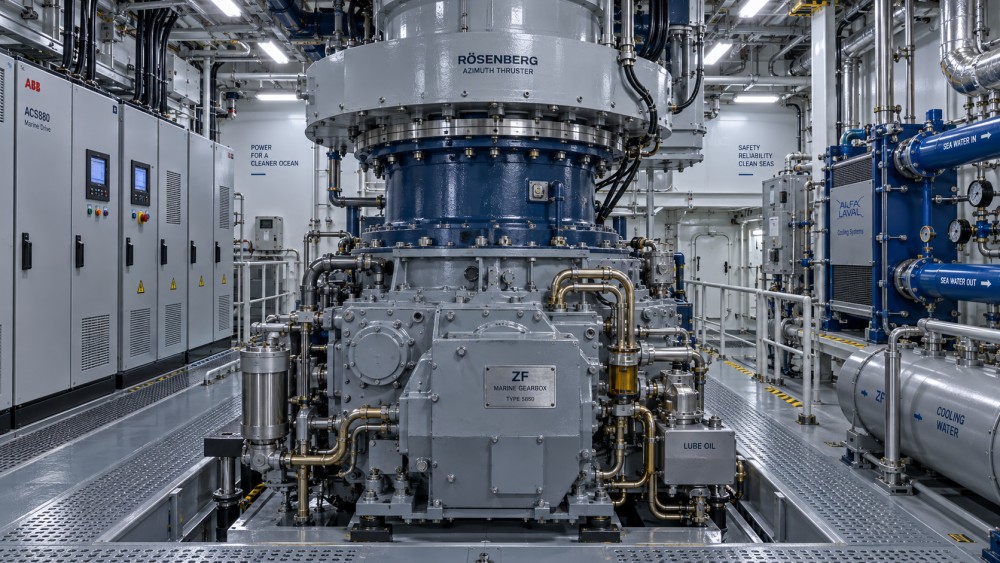
Electrical propulsion faults can stop a healthy-looking mechanical unit
On electric propulsion vessels, the thruster is part of a larger power and automation chain. The propulsor may be mechanically intact, yet unavailable because the motor, converter, cooling circuit, cabling, protection logic, or power-management interface has declared a fault.
Motor overheating and insulation deterioration
Thruster motors can overheat when cooling flow is inadequate, filters or heat exchangers are fouled, ventilation paths are obstructed, load is excessive, or electrical connections develop high resistance. Repeated thermal cycling can gradually weaken insulation. Moisture, vibration, contamination, and loose terminals can compound the problem.
An overtemperature trip should not automatically be treated as a failed temperature sensor. The useful investigation sequence is to confirm the actual motor temperature, check cooling performance, compare phase currents, inspect connections and insulation condition, and review whether the alarm occurred during unusual thrust demand or after a change in operating mode. Resetting the alarm without resolving the heat source may turn a recoverable issue into motor damage.
Variable-frequency drive and power-electronics faults
Variable-frequency drives (VFDs) provide the speed and torque control that make many modern azimuth propulsion systems efficient and responsive. They also introduce failure modes that differ from conventional fixed-speed propulsion. Cooling-system faults, contaminated cabinets, failed fans, capacitor aging, power-module faults, control-board defects, grounding issues, and unstable incoming power can all make a drive unavailable.
VFD fault codes are useful starting points, not final diagnoses. An overcurrent trip may be caused by a drive component, but it can also reflect a motor fault, a cable problem, a stalled or overloaded mechanical train, or an inappropriate ramp setting. Replacing a power module before checking the motor circuit and driven load risks both wasted parts and a repeat outage.
Steering and control failures can remove maneuverability even when thrust is available
An azimuth unit must produce thrust and point it accurately. Failures in the steering drive, hydraulic power unit, electric steering motor, gearbox, brakes, encoders, or control logic may leave a thruster locked in position, unable to follow commands, or declared unavailable by the vessel control system.
Hydraulic steering systems are vulnerable to leaks, low fluid level, contamination, pump wear, blocked filters, valve sticking, and pressure loss. Electric steering systems eliminate some hydraulic risks but depend heavily on motor health, gearbox condition, power supply quality, encoder feedback, and drive controls. Neither arrangement is inherently free of downtime; the relevant question is whether the installed system is monitored and maintained according to its actual duty cycle.
Position feedback deserves close attention. A failed or drifting encoder can cause a mismatch between commanded and reported azimuth angle. Control logic may then inhibit thrust, limit steering, or trigger a fault because it cannot safely confirm the unit's direction. Loose connectors, moisture in junction boxes, damaged cable runs, and intermittent network communication can produce faults that appear random until event data is reviewed in sequence.
Why fault finding often goes wrong
The most common diagnostic mistake is treating the last alarm as the first cause. A low lube-oil pressure alarm, for example, may be caused by a leak, clogged suction path, a failing pump, aerated oil, a faulty transmitter, or damage elsewhere in the lubrication circuit. Similarly, a VFD trip may be a protection response to a problem outside the VFD cabinet.
Another mistake is checking each subsystem in isolation. Azimuth thrusters couple mechanical loading, electrical demand, steering response, cooling, lubrication, and vessel automation. A useful investigation aligns these records on the same timeline: bridge command, thrust demand, azimuth angle, motor current, drive alarms, temperatures, pressure trends, vibration data, and recent maintenance actions. This often shows whether the event began under load, during a steering movement, after a power transition, or immediately after intervention on the equipment.
Intermittent faults should be treated seriously even if the unit can be reset. A nuisance trip may be a wiring or software issue, but it can also be the early stage of insulation breakdown, cooling degradation, sensor drift, or mechanical resistance. Repeated resets make later diagnosis harder because they erase the distinction between isolated events and a clear deteriorating trend.
Condition monitoring should match the failure mode
Routine inspection alone is not enough for equipment whose internal components cannot be visually assessed during normal operation. The most useful condition-monitoring approach combines several signals rather than relying on one threshold. Oil analysis helps reveal contamination and wear debris. Vibration monitoring can identify changes in bearings, gears, alignment, and rotating components. Temperature and pressure trends show cooling and lubrication performance. Electrical monitoring can reveal current imbalance, overload, insulation concerns, and converter stress. Control-system logs preserve the sequence that explains a trip.
Not every vessel needs the same monitoring depth. A harbor vessel with frequent starts, stops, and high steering activity may prioritize steering-system condition, cooling cleanliness, and operational alarms. A dynamically positioned offshore vessel has stronger reasons to focus on redundancy, common-cause risks, feedback integrity, and the impact of a single thruster outage on the operating envelope. Cruise ships and other vessels with high maneuverability expectations benefit from disciplined trend review because a propulsion limitation can quickly affect schedules and passenger operations.
For marine electric propulsion, the maintenance boundary should include the energy and control chain around the thruster, not only the underwater unit. MO-Core's coverage of VFD-driven and podded propulsion reflects this practical connection: reliability depends on how mechanical, electrical, and automation systems behave together under real vessel loads.
Plan spares around recovery time, not only failure probability
Critical-spares planning is often too focused on parts that fail frequently and not enough on components with long replacement lead times or difficult access. A seal kit, sensor, filter, or connector may be inexpensive but operationally critical if its absence prevents a return to service. Larger items such as bearings, gears, drive modules, motors, or steering components may be less practical to carry onboard, yet they should have an identified sourcing and repair path.
A sensible review separates consumables, fault-prone replaceable items, condition-based overhaul parts, and major repair assemblies. It should also account for the tools, lifting arrangements, software access, diagnostic equipment, and competent personnel needed to use those parts. A spare component does not reduce downtime if the vessel cannot safely install, configure, or test it.
What to check after an azimuth thruster trip
After safety and operating procedures are followed, the first task is to preserve evidence. Record alarms, timestamps, operating mode, commanded thrust, azimuth angle, power status, and the actions taken before reset. Then determine whether the failure is local to the thruster or linked to a shared system such as cooling, switchboard supply, power management, automation network, or common hydraulic service.
- Look for immediate signs of leakage, overheating, unusual noise, smoke, odor, or abnormal vibration before attempting repeated restarts.
- Review alarm history rather than only the active alarm, especially events leading up to the trip.
- Compare readings with the other thruster or with established normal trends, while allowing for different operating loads.
- Confirm lubrication, cooling, hydraulic pressure, steering feedback, electrical supply, and control communications.
- Escalate unexplained repeat trips into a structured root-cause investigation rather than accepting resets as a repair.
Frequently asked questions
Can an azimuth thruster keep operating with a minor oil leak?
That depends on the leak source and whether seawater can enter the gearcase. Any unexplained lubricant loss or change in oil condition should be investigated promptly. Continuing operation may be possible only within the vessel's approved operating procedures and after the risk to lubrication, sealing, and maneuverability has been assessed.
Are VFD failures more common than mechanical thruster failures?
They are different failure categories with different warning signs. Mechanical faults are often linked to wear, contamination, alignment, and lubrication. VFD faults are more influenced by cooling, power quality, electrical connections, component condition, and protection settings. A vessel's duty cycle and maintenance history determine which risk deserves more attention.
Why does a thruster trip only at high thrust?
High thrust exposes weaknesses that may remain hidden at lower load. The cause may be mechanical resistance, inadequate cooling, voltage drop, current limits, a developing bearing or gear problem, or a control limit reached during demanding operation. The load-dependent pattern is a useful diagnostic clue.
Should crews reset a thruster fault immediately?
A reset may be appropriate under established operating procedures, but repeated resets without understanding the alarm sequence are risky. Preserve the event data, check for signs of damage or unsafe conditions, and investigate recurring faults before returning the equipment to demanding service.