
Related News
- 00
0000-00
LNG Carrier Price Trends: What Shipbuyers Should Budget for Newbuilds - 00
0000-00
How to Evaluate Marine Semiconductor Suppliers for Shipboard Reliability - 00
0000-00
How Dual-Fuel Ships Cut Emissions Across Different Fuel and Operating Profiles - 00
0000-00
How to Select Low-Voltage Marine Drives for Electric Propulsion Below 1 kV - 00
0000-00
How to Evaluate Exhaust Gas Treatment System Suppliers for IMO Compliance Projects

Cruise interior fireproofing failures often begin with small specification gaps, poor material substitutions, or weak installation control—but their safety impact can be severe. For quality control and safety managers, understanding these high-risk mistakes is essential to reducing fire spread, protecting compliance, and maintaining passenger safety in complex cruise environments.
What cruise interior fireproofing really covers
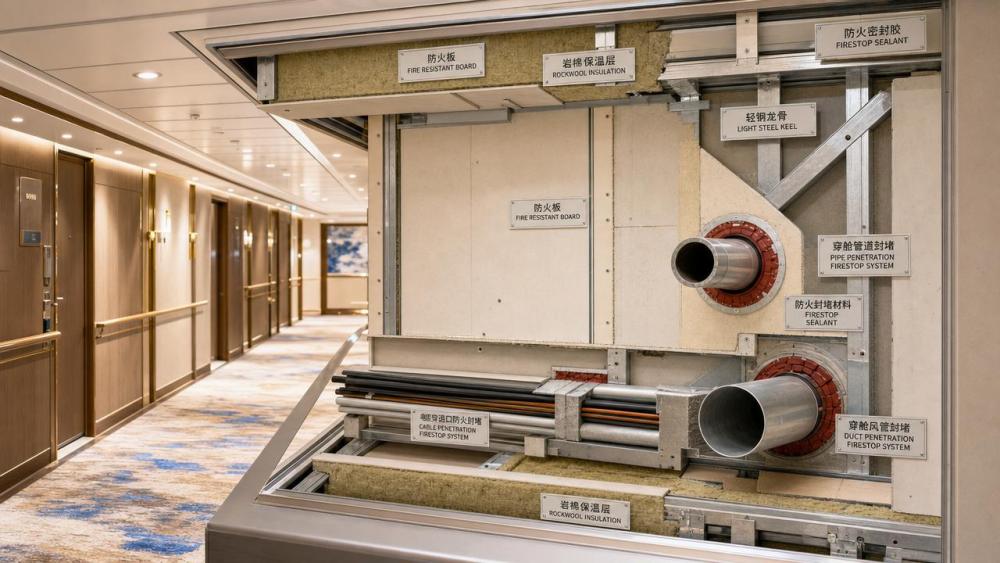
In modern passenger vessels, cruise interior fireproofing is not limited to decorative panels or visible cabin finishes. It includes the fire performance of wall systems, ceilings, insulation packages, flooring assemblies, penetrations, joinery details, adhesives, sealants, cable interfaces, and hidden voids behind luxury surfaces. In practice, the topic sits at the intersection of material science, onboard system integration, workmanship control, and regulatory compliance.
For quality control teams, this means a fire-safe interior is never created by one certified board or one compliant coating alone. It is achieved when the full assembly performs as intended under realistic onboard conditions. For safety managers, the concern is even broader: if one part of the assembly is altered, substituted, poorly fitted, or damaged during outfitting, the designed fire boundary may be weakened long before the vessel enters service.
This is why cruise interior fireproofing remains a priority topic in high-end shipbuilding. Cruise ships combine hotel-grade comfort, dense occupancy, extensive electrical systems, complex HVAC routing, and strict evacuation requirements. A small installation mistake in a concealed area can become a major risk multiplier when heat, smoke, and passenger movement interact during an incident.
Why the maritime industry pays close attention
The cruise segment is often described as a floating city, but from a fire protection perspective it is more demanding than many land-based buildings. Interior spaces are highly compartmentalized, premium aesthetics can encourage material layering, and refurbishment cycles may introduce repeated changes over time. In addition, ship operators must align fire safety decisions with SOLAS principles, IMO expectations, class rules, flag requirements, and owner-specific specifications.
MO-Core’s observation of luxury cruise systems shows that one of the most persistent tensions in vessel design is the balance between lightweighting and safety redundancy. Designers want lower weight, better energy efficiency, and more design flexibility. Operators want durability, easier maintenance, and premium guest experience. Regulators and safety leaders, however, cannot compromise on the integrity of fire boundaries, low flame spread performance, smoke limitation, and system resilience. This tension creates exactly the kind of environment where cruise interior fireproofing mistakes can emerge.
Another reason for concern is the complexity of global supply chains. Interior outfit packages may involve multiple subcontractors, approved samples from one batch, production materials from another source, and late-stage changes driven by cost or schedule pressure. Even when each party believes the change is minor, the cumulative effect can undermine fire performance.
Common mistakes that raise safety risks
The most serious cruise interior fireproofing failures are rarely dramatic at first glance. They often start as ordinary project deviations. The following mistakes are especially relevant for quality and safety managers:
- Material substitution without full equivalency review: replacing approved panels, insulation, fabrics, veneers, or sealants with “similar” products that do not match tested fire performance.
- Assembly-based approvals misunderstood as material approvals: using a certified component outside the tested build-up, thickness, backing, fixing method, or joint condition.
- Poor control of penetrations: cable, pipe, duct, and fastener penetrations left unsealed, overcut, or reworked without restoring the original fire barrier.
- Weak installation quality: gaps at panel joints, inconsistent edge treatment, missing insulation continuity, and poor alignment at doors or service interfaces.
- Combustible hidden additions: acoustic fillers, packaging remnants, temporary protections, decorative backings, or unapproved adhesive layers left behind in concealed spaces.
- Late design changes not reflected in fire documentation: revised layouts, retail concepts, cabin upgrades, or entertainment zones introduced without updated fire risk validation.
- Inadequate refurbishment governance: during retrofit or hotel upgrades, legacy conditions may be covered rather than corrected, masking degradation in cruise interior fireproofing performance.
A practical overview for QC and safety teams
To manage cruise interior fireproofing well, teams need a structured view of where failures usually occur and what kind of consequence each failure can trigger. The table below provides a practical overview for shipyards, outfit integrators, owner representatives, and onboard safety functions.
Where mistakes usually come from
Although technical failure is the visible outcome, the root causes are often managerial. One common issue is fragmented accountability. Design, procurement, installation, and inspection may be handled by different teams with different decision priorities. If nobody owns the continuity of the approved fire strategy, cruise interior fireproofing becomes vulnerable at every handover point.
Schedule compression is another driver. Interior works are frequently exposed to late changes because aesthetic decisions continue deep into production. When dates cannot move, teams may accept temporary fixes, undocumented substitutions, or partial close-outs. These shortcuts are especially dangerous in hidden zones that are hard to re-open after completion.
Documentation gaps also matter. Certificates may exist, but if they are not tied to exact lot numbers, installation methods, thicknesses, and locations, they provide limited assurance. A certificate in a file is not the same as verified compliance in the vessel. For quality control personnel, traceability must connect approved design intent to installed reality.
Business value of getting fireproofing right
Strong cruise interior fireproofing control is not only a safety obligation. It also protects commercial performance. A nonconformity discovered late can delay handover, increase rework cost, trigger class or flag findings, and disrupt commissioning. In service, poor interior fire protection can lead to route interruptions, expensive repairs, reputational damage, and loss of passenger confidence.
For owners and builders working in premium cruise programs, consistent fireproofing quality also supports brand value. Luxury design is only credible when hidden systems are as robust as visible finishes. In a market where sustainability, advanced engineering, and safe passenger experience are increasingly linked, cruise interior fireproofing is part of the vessel’s overall quality narrative, not an isolated compliance box.
Key application scenarios that deserve special attention
Not all interior zones present the same level of fireproofing challenge. QC and safety managers should prioritize areas where passenger density, ignition sources, design complexity, or concealed interfaces are high.
- Cabin clusters and escape routes: These spaces directly affect evacuation safety. Surface spread, smoke generation, and boundary integrity must remain tightly controlled.
- Atriums, lounges, and retail zones: Signature design features can involve mixed materials, lighting integration, and custom furniture systems that challenge standard approvals.
- Galleys adjacent to passenger areas: Interfaces between operational zones and hospitality spaces require careful fire separation and penetration management.
- Refurbishment packages: Existing conditions, unknown modifications, and incomplete records make retrofit work one of the highest-risk periods for cruise interior fireproofing errors.
Practical control measures for quality and safety managers
A reliable control framework should begin before installation and continue through close-out. First, define the approved assembly logic, not just a list of approved products. Teams need to know which combinations of substrate, insulation, finish, joint detail, and fixing method were actually qualified. This avoids the common mistake of treating every certified material as universally interchangeable.
Second, build a substitution gate that is technical rather than administrative. Any proposed material or detail change should be reviewed for fire performance, smoke behavior, interface impact, and regulatory acceptance. If the review happens too late, cost pressure may override safety judgment.
Third, inspect concealed areas before closure. For cruise interior fireproofing, many of the most critical defects disappear once ceilings, liners, or decorative panels are fixed in place. Hold points should therefore target penetrations, insulation continuity, void cleanliness, and edge sealing before access is lost.
Fourth, connect documentation with field verification. Certificates, test reports, installation instructions, and as-built records should be checked against what is physically installed. Barcode-based traceability, photographic evidence, and compartment-level punch tracking can improve reliability in large cruise programs.
Finally, involve operations early. Shipboard safety teams, hotel maintenance leaders, and refit planners should understand the original fireproofing assumptions so that future repairs or design upgrades do not unintentionally degrade them.
A short FAQ for internal alignment
Is certified material enough to prove compliant cruise interior fireproofing?
No. Certification must match the installed assembly, use condition, and location. A compliant material can still create a noncompliant system if installed differently from the tested configuration.
Why are hidden spaces so important?
Because smoke and fire can travel through concealed voids, and many installation defects are hidden there. Ceiling spaces, service shafts, and behind-panel zones deserve focused inspection.
When do most fireproofing mistakes occur?
Typically during late procurement changes, fast-track outfitting, interface rework, and refurbishment phases where documentation and access are weakest.
Closing perspective
For cruise operators, shipyards, and specialist suppliers, the lesson is clear: cruise interior fireproofing is a system discipline, not a decorative afterthought. The highest risks usually come from minor deviations that seem manageable in isolation but become serious when multiplied across hundreds of cabins, public areas, and hidden interfaces.
Quality control and safety managers can reduce those risks by focusing on assembly integrity, substitution governance, concealed-area inspection, and traceable close-out. In the broader context of advanced cruise engineering and maritime compliance, that disciplined approach supports not only safer vessels, but also more resilient delivery, stronger lifecycle performance, and greater confidence in high-value passenger ship programs.
For organizations tracking design evolution, lightweighting pressure, and regulatory expectations across the global cruise sector, a deeper understanding of cruise interior fireproofing is an essential part of informed decision-making. It is one of the areas where hidden technical detail has visible operational consequences.