
Related News
- 00
0000-00
How to Evaluate an Integrated Propulsion Manufacturer for Vessel Retrofit Projects - 00
0000-00
LNG Carrier Price Trends: What Shipbuyers Should Budget for Newbuilds - 00
0000-00
How to Evaluate Marine Semiconductor Suppliers for Shipboard Reliability - 00
0000-00
How Dual-Fuel Ships Cut Emissions Across Different Fuel and Operating Profiles - 00
0000-00
How to Select Low-Voltage Marine Drives for Electric Propulsion Below 1 kV

As 2026 approaches, maritime emission rules may reshape fuel choices, retrofit timelines, and compliance budgets across global fleets. For business decision-makers, understanding how maritime emission policy could influence operating costs is critical to protecting margins and planning long-cycle investments. This article outlines the likely regulatory shifts and their commercial impact on vessel efficiency, equipment strategy, and competitive positioning.
Why is maritime emission becoming a bigger cost question in 2026?
The short answer is that 2026 is shaping up as a decision point rather than a single regulatory deadline. Many shipowners and equipment suppliers are not waiting for one dramatic rule change; they are preparing for a more demanding compliance environment built from several layers: IMO carbon-intensity pressure, regional fuel standards, tighter scrutiny of methane slip, local port requirements, and stronger enforcement on reporting accuracy. Together, these trends can raise the total cost of operating a vessel even if the headline fuel price remains stable.
For business leaders, the core issue is not only whether a ship is technically compliant. The real question is how maritime emission exposure changes voyage economics, asset values, charter attractiveness, and retrofit timing. A vessel that technically passes one rule may still lose commercial appeal if it consumes more fuel, carries a weak emissions profile, or faces higher carbon-related charges in certain trades.
This matters especially in high-value segments such as LNG carriers, cruise systems, offshore engineering vessels, and electrically integrated ships. These assets have long investment cycles, specialized operating profiles, and significant capital tied to propulsion, exhaust treatment, and energy-management systems. In these segments, maritime emission policy is no longer a compliance topic handled at the end of a design review. It is becoming a board-level cost and competitiveness issue.
Which parts of the 2026 maritime emission landscape are most likely to affect operating costs?
Decision-makers should watch five areas closely, because each one can change cost in a different way.
First, carbon-intensity compliance may become more expensive. Even where direct carbon pricing is still evolving, fleets are already absorbing the cost of slower steaming, route optimization software, fuel-efficiency upgrades, and technical modifications needed to protect ratings and reduce consumption. If a vessel underperforms on efficiency, the penalty is often commercial before it is legal: weaker charter terms, reduced schedule flexibility, or forced operational compromises.
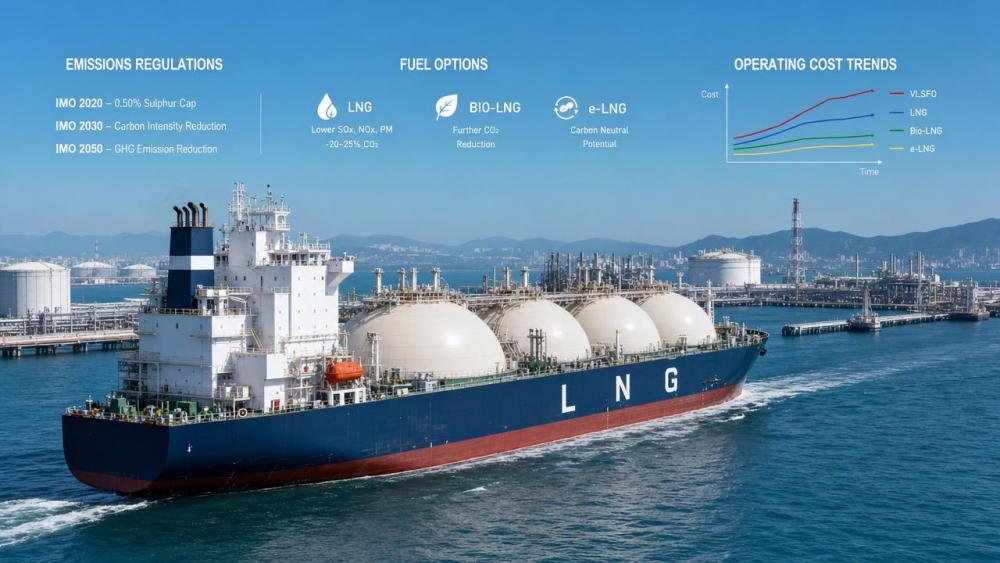
Second, fuel choice uncertainty can widen cost gaps. Conventional low-sulfur fuel, LNG, biofuels, methanol pathways, and hybrid electric solutions each create a different cost structure. Maritime emission rules increasingly influence not just what fuel can be burned, but how lifecycle emissions, methane slip, and supply-chain traceability are judged. That means the cheapest fuel today may not be the most resilient compliance option by 2026.
Third, aftertreatment and retrofit spending may rise. Scrubbers, SCR systems, engine tuning packages, shore-power interfaces, onboard monitoring, and digital reporting tools all involve capex, downtime, and integration risk. For complex vessels, the engineering challenge is not the hardware alone; it is the interaction between power systems, safety requirements, layout constraints, and operational redundancy.
Fourth, data compliance is becoming a hidden cost center. Maritime emission management now depends on credible fuel and emissions data. Poor sensor reliability, inconsistent reporting, or fragmented data platforms can trigger auditing headaches, management delays, and poor strategic decisions. Many operators underestimate the staffing and systems burden required to maintain accurate reporting across fleets.
Fifth, regional fragmentation creates route-specific cost exposure. A vessel trading globally may face a different compliance burden in Europe, Asia, and local port jurisdictions. This makes maritime emission planning a trade-lane issue, not just a fleet issue.
Which vessels and business models are likely to feel the strongest impact?
The strongest impact will usually fall on operators with one or more of the following characteristics: fuel-intensive voyages, high hotel loads, complex power architecture, sensitive charter economics, or long-lived assets that cannot be replaced quickly.
For LNG carriers, maritime emission discussions are increasingly tied to methane management. LNG remains important in transition strategies, but regulators and customers are paying closer attention to slip rates, boil-off handling, engine selection, and the true emissions profile of different containment and propulsion combinations. A technically advanced LNG carrier may gain a strong commercial edge if it can document lower real-world emissions and better fuel utilization.
For luxury cruise operators, the pressure is broader. Cruise ships face not only fuel and propulsion challenges, but also public visibility, port restrictions, hotel power demand, and strict expectations around sustainability branding. Maritime emission costs here extend beyond fuel bills into shore-power compatibility, exhaust treatment redundancy, interior integration constraints, and reputational risk.
For offshore engineering and specialized vessels, cost exposure depends heavily on duty cycle. Dynamic positioning, standby loads, peak power swings, and project-specific operating patterns can make efficiency improvement difficult. However, these vessels may also benefit significantly from advanced electrical integration, variable frequency drive optimization, and energy-storage support where technically justified.
For shipyards, system integrators, and equipment suppliers, the impact is indirect but substantial. Customers are increasingly purchasing “compliance confidence,” not only hardware. Suppliers that can explain how their propulsion, scrubber, SCR, digital monitoring, or cryogenic systems reduce lifecycle maritime emission risk will have a stronger sales position.
How should executives compare fuel, retrofit, and efficiency options before 2026?
A useful way to compare options is to move beyond simple fuel-price calculations. Maritime emission strategy should be evaluated through total operating impact over several years, including compliance flexibility, downtime, maintenance complexity, and residual asset value.
Start with four practical questions. First, how exposed is the vessel to tightening carbon-intensity expectations on its actual routes? Second, how difficult is it to retrofit without disrupting revenue service? Third, does the chosen solution improve technical efficiency in normal operations, not just in test conditions? Fourth, will the asset remain commercially attractive if future maritime emission rules become more demanding than expected?
This comparison shows why no single answer fits every fleet. In many cases, the best maritime emission response is a sequence: optimize operations first, then target high-return retrofits, and only then commit to major fuel-path investments once route exposure and commercial assumptions are clearer.
What cost items are companies most likely to underestimate?
The most commonly underestimated cost is integration. A new emissions-control device or alternative-fuel system may look manageable on paper, but real installation can affect piping, electrical loads, control logic, ventilation, fire safety, cryogenic handling, crew procedures, and class approval timelines. On specialized ships, these interactions are often more expensive than the equipment itself.
The second overlooked item is off-hire and schedule disruption. Maritime emission compliance is rarely just a procurement exercise. Yard slots, engineering design freezes, testing windows, and crew familiarization all affect revenue timing. Delayed retrofits can cost more than accelerated ones if the vessel misses contract opportunities or enters a region with stricter operating constraints.
Another underestimated area is data assurance. If a company cannot prove fuel performance, emissions behavior, or the efficiency benefits of a new system, it may fail to capture the commercial upside of its investment. Charterers, financiers, insurers, and regulators increasingly want evidence, not claims. A robust maritime emission strategy therefore includes metering quality, digital integration, reporting governance, and internal accountability.
Finally, many firms underestimate the strategic cost of waiting too long. A late decision can narrow equipment availability, reduce yard options, weaken supplier negotiating power, and force a company into a short-term compliance fix instead of a better long-term solution.
What are the biggest mistakes companies make when responding to maritime emission pressure?
One common mistake is treating maritime emission solely as a regulatory checkbox. This mindset leads to minimum-compliance investments that solve one rule while making the vessel less flexible for future trades or fuel transitions. A narrow view may lower immediate capex but increase long-term operating cost.
A second mistake is assuming all low-carbon technologies deliver value in the same way. For example, electric propulsion enhancements may be highly effective for variable-load vessels but offer weaker returns for ships with steady operating profiles. Likewise, LNG solutions can be attractive in some segments yet vulnerable where methane reporting expectations become more influential.
A third mistake is separating technical and commercial evaluation. The engineering team may focus on feasibility, while finance focuses on capex, and chartering focuses on market demand. But maritime emission decisions work best when these views are integrated early. The right question is not “Can we install it?” but “Will this improve compliance, economics, and competitiveness together?”
The last major mistake is ignoring stakeholder signaling. Customers, lenders, and strategic partners increasingly use emissions readiness as a proxy for management quality and future resilience. Even before hard rules tighten, market perception can alter financing terms and contract opportunities.
How can decision-makers prepare now without overcommitting too early?
The most effective approach is staged preparation. First, build a vessel-by-vessel maritime emission exposure map covering route profile, fuel type, age, efficiency baseline, retrofit constraints, and likely commercial life. This prevents broad policy assumptions from driving poor asset-level decisions.
Second, prioritize actions with immediate operational value. Energy-management software, propulsion tuning, hull and machinery efficiency upgrades, and better data visibility can often improve both compliance positioning and fuel spend, regardless of how 2026 rules finally land.
Third, identify “no-regret” engineering studies. Even if a major retrofit is not approved yet, pre-engineering work on SCR integration, scrubber feasibility, shore power readiness, LNG system optimization, or electric propulsion upgrades can shorten execution time later and improve vendor negotiations.
Fourth, monitor the policy-commercial connection, not just the regulation text. Maritime emission policy matters because it changes freight competitiveness, customer preference, and asset bankability. Companies that track these linked effects will make better investment calls than those focused only on formal compliance dates.
What should companies clarify first when discussing solutions, budgets, or partnerships?
Before selecting a technology or requesting quotations, companies should align on a short list of business-critical questions: Which vessels face the highest maritime emission cost exposure by trade lane? What is the acceptable payback period? How much off-hire can operations tolerate? Does the solution improve future optionality or lock the fleet into one pathway? Can performance be measured credibly after installation? And how will the investment influence charter value, customer confidence, and financing conversations?
For decision-makers in advanced marine segments, the next step is not to chase every new claim in the decarbonization market. It is to connect engineering detail with commercial consequence. If you need to confirm a practical maritime emission roadmap, start by discussing vessel profile, emissions baseline, retrofit window, data requirements, and the expected impact on operating cost over the next contract cycle. That creates a stronger basis for technical selection, budget planning, and partner engagement.